Perplexity Deep Research: The Future of AI-Powered Knowledge Exploration
Artificial Intelligence (AI) is revolutionizing the way we conduct research, and Perplexity AI has taken a significant step forward with its latest feature: Deep Research. Designed to provide expert-level insights with real citations, this tool aims to bridge the gap between consumer chatbots and professional research applications. With industry leaders like OpenAI and Google also launching similar tools, the race for AI-powered deep research is heating up.
In this article, we’ll dive into Perplexity‘s Deep Research, how it compares with its competitors, and what it means for professionals, researchers, and businesses. We will also explore the impact of AI in research, potential future developments, and ethical considerations surrounding AI-driven analysis.
What is Perplexity Deep Research?
Perplexity Deep Research is an AI-driven tool that enhances research capabilities by iteratively searching, reading documents, and refining its approach as it gathers more data. Unlike standard AI chatbots, which provide quick but often superficial answers, Deep Research is built for in-depth analysis, making it ideal for professionals in finance, marketing, healthcare, law, and product research.
Key Features:
- Advanced Search Capabilities: Uses iterative searches to gather relevant data from multiple sources, ensuring comprehensive results.
- Expert-Level Analysis: Designed to handle complex, professional research queries with a focus on accuracy and depth.
- Citations and Sources: Provides real citations, ensuring credibility and traceability of information.
- Multi-Platform Availability: Accessible on the web and soon on Mac, iOS, and Android, offering convenience to researchers across different devices.
- Exportable Reports: Users can generate detailed reports in PDF format or as sharable Perplexity Pages, making it easier to document findings.
- Speed & Efficiency: Completes research in under three minutes, significantly reducing the time spent on manual research.
How Does It Compare to Other Deep Research Tools?
OpenAI Deep Research
- Strengths: Superior analytical depth, making it highly valuable for enterprises and scientific research.
- Weaknesses: Requires a $200/month Pro subscription, limiting accessibility for casual users and independent researchers.
- Performance: Takes between 5 to 30 minutes to generate in-depth research reports.
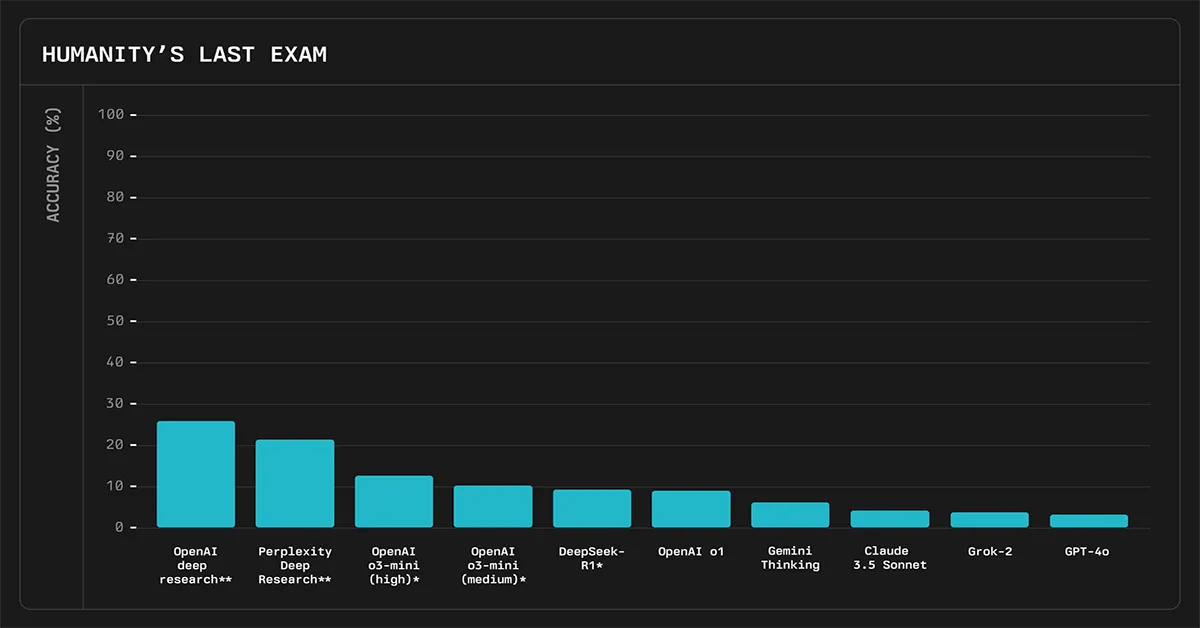
- Benchmark Score: 26.6% on Humanity’s Last Exam, showcasing its high-level analytical capability.
Google Gemini Deep Research
- Strengths: Best integration with existing productivity tools like Google Docs and Google Search.
- Weaknesses: Limited accessibility and currently lacks a dedicated pricing model for users.
- Performance: Faster than OpenAI but lacks the deep analytical rigor needed for complex research topics.
- Benchmark Score: 6.2% on Humanity’s Last Exam, reflecting its relatively weaker research capabilities.
Perplexity Deep Research
- Strengths: Fast, accessible, and free for non-subscribers (with a limited number of queries per day), making it ideal for both professionals and casual researchers.
- Weaknesses: Slightly lower performance score than OpenAI (21.1% vs. 26.6%), which may affect highly specialized research applications.
- Performance: Completes research in under three minutes, significantly faster than OpenAI’s Deep Research.
- Benchmark Score: 21.1% on Humanity’s Last Exam, outperforming Google Gemini but slightly lagging behind OpenAI.
Who Benefits Most from Perplexity Deep Research?
-
Professionals & Academics
Researchers, analysts, and academics can benefit from credible citations and expert-level insights, reducing the time needed to sift through multiple sources.
-
Marketers & Business Analysts
Businesses can leverage AI-powered research to gather market insights, competitive analysis, and consumer trends without costly research teams, enhancing decision-making.
-
Students & Educators
Students can use Deep Research for assignments, essays, and thesis development, while educators can incorporate AI-generated reports into lesson planning, improving efficiency.
-
Journalists & Writers
Journalists can use Deep Research for fact-checking and gathering background information on complex topics, ensuring accuracy and reliability in their reporting.
-
Healthcare & Legal Professionals
AI-powered research can assist in medical case studies, legal precedents, and policy analysis, offering well-referenced insights that save time and effort.
Potential Limitations and Concerns
While Perplexity Deep Research is a groundbreaking tool, some concerns remain:
- Over-reliance on AI: Automating research could reduce human critical thinking and the ability to derive novel insights from the data.
- Bias in Data Sources: AI relies on available data, which may sometimes lack diversity or credibility, affecting research outcomes.
- Comparative Accuracy: While Perplexity outperforms many models, OpenAI’s Deep Research still leads in analytical depth, making it a better choice for highly technical subjects.
- Ethical Concerns: The increasing reliance on AI for research may raise ethical issues regarding intellectual property, data privacy, and misinformation.
Future of AI-Powered Research
As AI research tools like Perplexity Deep Research continue to evolve, we can expect improvements in:
- Personalized Research Models: Tailored AI research based on user preferences and industry-specific needs.
- Real-Time Data Analysis: AI that can analyze real-time trends in finance, healthcare, and marketing, providing up-to-the-minute insights.
- Enhanced Integration: Seamless integration with platforms like Google Scholar, academic databases, and industry reports.
- More Transparent AI Models: Improved explainability of AI research processes to ensure users understand how insights are derived.
Conclusion
Perplexity Deep Research is a game-changer in the AI research landscape, offering speed, accessibility, and expert-level analysis at an affordable price point. While OpenAI and Google have their strengths, Perplexity’s approach to democratizing deep research makes it a valuable tool for professionals, students, and businesses alike.
As AI research tools continue to evolve, the key challenge will be balancing automation with human creativity and critical thinking. Will AI replace traditional research methods entirely? Probably not. But it will certainly make the process faster, smarter, and more efficient.
Frequently asked questions.
Answers connected directly to this article and its subject.
01 What makes Perplexity Deep Research different from traditional AI chatbots?
Perplexity Deep Research focuses on expert-level analysis and provides real citations, making it suitable for professional use cases unlike standard chatbots.
02 Is Perplexity Deep Research free?
Yes, non-subscribers get a limited number of free queries daily, while paying subscribers enjoy unlimited access.
03 How fast does Perplexity Deep Research generate reports?
Most research tasks are completed in under three minutes, much faster than OpenAI’s Deep Research (5–30 minutes).
04 Can I export reports from Perplexity Deep Research?
Yes, users can export detailed research reports as PDFs or Perplexity Pages for sharing.
05 How does Perplexity’s accuracy compare to OpenAI and Google?
Perplexity scored 21.1% on Humanity’s Last Exam, outperforming Google’s Gemini (6.2%) but trailing behind OpenAI (26.6%).