- Claude 3.7 Sonnet and Claude Code: The Future of AI-Powered Development
- What Is Claude 3.7 Sonnet?
- Claude 3.7 Sonnet’s availability and pricing
- Introducing Claude Code: AI-Powered Development
- How Claude Sonnet 3.7 and Claude Code Improve AI-Powered Development
- Claude Sonnet 3.7 : Enhanced Performance in Coding, Finance, and Legal Tasks
- Conclusion
Claude 3.7 Sonnet and Claude Code: The Future of AI-Powered Development
Artificial intelligence is evolving at a rapid pace, and Claude 3.7 Sonnet is at the forefront of this revolution. Developed with cutting-edge reasoning capabilities, Claude 3.7 Sonnet represents a major leap in AI-driven automation, problem-solving, and software development. Alongside it, Claude Code is set to redefine how developers interact with AI in coding, debugging, and full-stack development.
In this article, we’ll explore the key features of Claude 3.7 Sonnet, its applications, and how Claude Code enhances software engineering. Whether you’re a developer, business leader, or AI enthusiast, understanding these advancements will help you stay ahead in an AI-driven world.
What Is Claude 3.7 Sonnet?
Claude 3.7 Sonnet is an advanced AI model designed to provide both instant responses and deep reasoning capabilities. Unlike traditional models that focus solely on speed or depth, this hybrid model offers the best of both worlds.
Key Features of Claude 3.7 Sonnet
- Hybrid Reasoning Model: Capable of quick responses and extended thinking for complex problems.
- Enhanced Coding Capabilities: Excels in front-end development, debugging, and test-driven development.
- Budget-Controlled AI Thinking: Users can set limits on how much AI should ‘think’ before responding.
- Business-Optimized AI: Instead of focusing only on academic AI challenges, it prioritizes real-world applications.
- Multi-Platform Availability: Available on Anthropic API, Amazon Bedrock, Google Cloud’s Vertex AI, and various Claude plans.
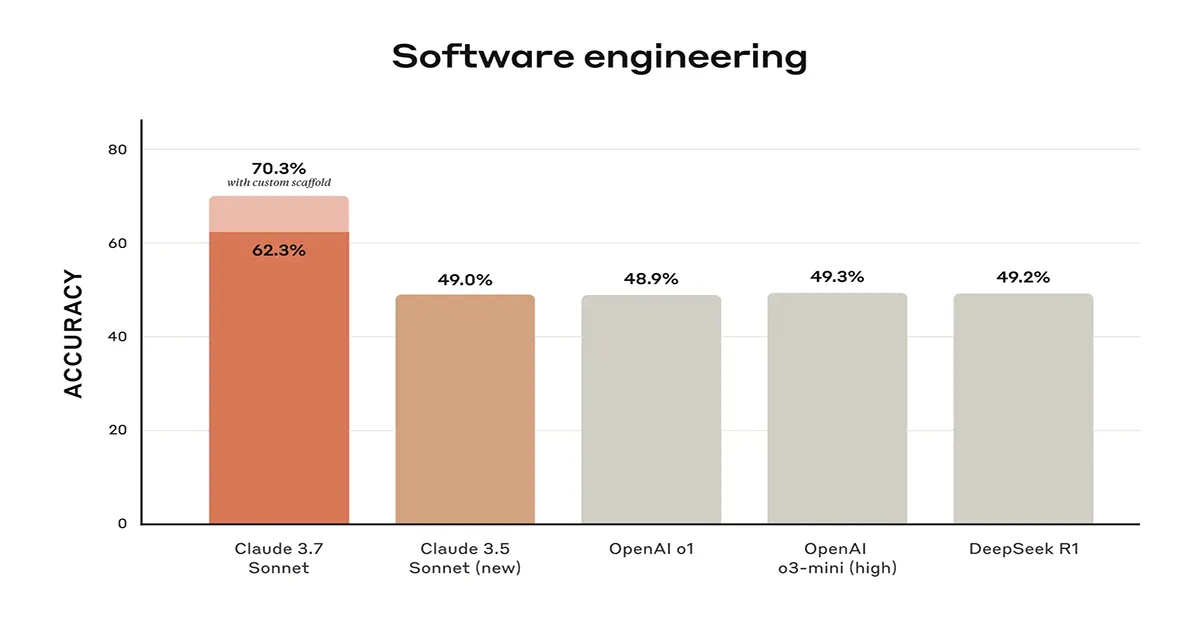
- State-of-the-Art Performance: Outperforms competitors in SWE-bench Verified and TAU-bench benchmarks.

Why It Matters
Claude 3.7 Sonnet isn’t just another AI model; it’s built to augment human intelligence by automating tedious tasks while allowing users to retain control over AI decision-making. The ability to choose between quick answers and deep reasoning makes it a game-changer for industries like software development, finance, healthcare, and research.
Claude 3.7 Sonnet’s availability and pricing
Claude 3.7 Sonnet is accessible across all Claude subscription plans, including Free, Pro, Team, and Enterprise. Additionally, it is available via the Anthropic API, Amazon Bedrock, and Google Cloud’s Vertex AI. However, Extended Thinking Mode is limited to all tiers except the free plan.
Both the standard and extended thinking modes are priced the same as previous versions, maintaining a cost of $3 per million input tokens and $15 per million output tokens, which also covers thinking tokens.
Introducing Claude Code: AI-Powered Development
To further enhance developer productivity, Claude Code is introduced as a powerful agentic coding tool. Currently available in a limited research preview, Claude Code takes AI-assisted programming to new heights.
What Can Claude Code Do?
- Autonomous Code Assistance: Acts as an active coding collaborator, performing tasks with minimal manual input.
- Search and Analyze Code: Reads and understands codebases to provide better suggestions.
- Edit and Debug Code: Automatically detects issues and applies fixes.
- Write and Run Tests: Helps in test-driven development, reducing bugs before deployment.
- Commit and Push Code to GitHub: Automates version control, making collaborative development easier.
- Use Command-Line Tools: Interacts with terminal commands, reducing manual efforts.
- Large-Scale Refactoring: Excels at restructuring large codebases efficiently.
Real-World Applications of Claude Code
Several companies have tested Claude Code, with impressive results:
- Cursor: Found Claude best-in-class for handling complex codebases.
- Cognition: Reported Claude’s superior ability in planning code changes and updating full-stack applications.
- Replit: Used Claude Code to build web apps and dashboards with unmatched efficiency.
- Canva: Noted Claude’s design precision and reduced error rates in production-ready code.
For developers, Claude Code saves hours of manual work, making it an invaluable tool for coding, debugging, and maintaining large-scale applications. In early testing, Claude Code completed tasks in a single pass that would normally take 45+ minutes manually, significantly improving efficiency and reducing overhead.
How Claude Sonnet 3.7 and Claude Code Improve AI-Powered Development
1. Faster and More Reliable Software Development
With state-of-the-art coding capabilities, developers can now rely on Claude to generate, analyze, and debug code more efficiently. Claude Code reduces development time significantly, making it easier to manage complex projects. Instead of spending hours manually debugging or writing test cases, developers can focus on creative problem-solving, while Claude takes care of repetitive coding tasks.
Moreover, AI-powered automation enables teams to deliver high-quality software faster, reducing the risk of bugs and improving overall software reliability. By integrating Claude into the software development workflow, companies can accelerate product development cycles and meet deadlines more efficiently.
2. More Control Over AI Thinking Time
Unlike other AI models, Claude Sonnet 3.7 lets developers set a budget for AI reasoning. This means you can prioritize speed or quality depending on the task at hand. For example, when performing quick syntax corrections, developers can limit the response time to milliseconds, ensuring instant feedback. On the other hand, for more complex decision-making tasks, developers can allow the AI to spend more time analyzing before providing an answer.
This level of control allows developers to fine-tune AI behavior based on project needs, ensuring optimal performance in different scenarios.
3. Seamless GitHub Integration Across All Plans
Developers can now connect Claude directly to their GitHub repositories, allowing AI to suggest edits, push updates, and maintain software projects effortlessly. GitHub integration is now available across all Claude plans, making AI-assisted development more accessible than ever.
By leveraging GitHub integration, developers can collaborate more effectively, track code changes in real-time, and ensure a smoother development workflow. The ability to automatically review and suggest code improvements significantly reduces manual review time and enhances project scalability.
4. Superior Reasoning and Decision-Making
Whether it’s answering coding-related questions or tackling real-world AI problems, Claude Sonnet 3.7 has proven to be the most advanced model in reasoning-based AI interactions. This superior reasoning ability allows developers to solve complex problems more efficiently, optimize algorithms, and make informed design decisions faster.
Furthermore, Claude’s ability to understand context, logic, and intent ensures that AI-generated code aligns with project requirements and best practices, improving code quality and maintainability.
5. Continuous Improvements and Future Enhancements
Anthropic is actively working on enhancing Claude Code by:
- Improving tool call reliability to ensure consistent performance.
- Adding support for long-running commands, enabling more complex operations.
- Enhancing in-app rendering for better developer experience.
- Expanding Claude’s understanding of its capabilities, making it even more effective as a coding assistant.
By joining the research preview, developers have a unique opportunity to provide feedback and shape the future of AI-powered coding. As more users engage with Claude Code, its capabilities will continue to evolve, making it an essential tool for modern software development.
Claude Sonnet 3.7 : Enhanced Performance in Coding, Finance, and Legal Tasks
Penn states that Claude Sonnet 3.7 demonstrates significant improvements in agentic coding, finance, and legal tasks. Although it does not yet feature real-time web search, its knowledge cut-off date extends to October 2024, making it more up-to-date than previous versions. Additionally, Anthropic is giving developers greater control over how the model processes information, allowing them to steer its reasoning via a scratchpad and even set specific response time limits.
“Sometimes, a developer needs the model to respond in no more than 200 milliseconds,” explains Michael Gerstenhaber, Anthropic’s VP of Product, emphasizing that such decisions are product-driven.
Within Anthropic, employees have leveraged Claude Sonnet 3.7 to design front-end websites, develop interactive games, and spend up to 45 minutes refining code, iterating through test set creation and case modifications to enhance efficiency.
She explains that the company evaluates its models by testing their ability to navigate and progress in a classic Pokémon video game. By mapping the model’s API to a controller scheme, they found that Claude 3.5 Sonnet struggled to move beyond Pallet Town, the game’s starting point. In contrast, Claude Sonnet 3.7 demonstrated significant improvement, successfully defeating multiple gym leaders.
Meanwhile, the AI model race is accelerating at an unprecedented pace, as demonstrated by Elon Musk’s recent unveiling of Grok-3. However, at this stage, Anthropic appears to have regained the lead, thanks to Claude 3.7 Sonnet’s superior performance. Its release also signals a shift in the industry—rather than developing separate reasoning models, the trend is moving toward versatile AI capable of handling multiple tasks within a single framework.
Bug in Anthropic’s Claude Code Tool Caused System Failures
Anthropic’s launch of its coding tool, Claude Code, has faced issues after a bug was discovered in the auto-update function. According to reports on GitHub, the buggy commands caused instability and malfunction in some workstations. When Claude Code was installed at the “root” or “superuser” level, which grants the program the ability to make system-level changes, the faulty commands allowed applications to alter restricted file directories, potentially “bricking” the system.
The issue arose when the auto-update commands changed access permissions for critical system files. These permissions determine who can read, modify, or run specific files or applications. One GitHub user mentioned needing a “rescue instance” to restore the permissions of files that were affected by Claude Code’s commands.
In response, Anthropic informed TechCrunch that they removed the faulty commands and included a link in the program directing users to a troubleshooting guide. However, the initial link had a typo, which has now been corrected.
Conclusion
Claude Sonnet 3.7 and Claude Code mark a significant leap in AI-assisted development. By blending fast responses with deep reasoning, Claude Sonnet 3.7 ensures that businesses and developers can harness AI’s full potential without compromising quality.
For those looking to enhance software development, streamline workflows, and stay competitive in AI-powered industries, Claude Sonnet 3.7 and Claude Code are must-have tools.
Interested in exploring Claude Code? Join the research preview today and experience the next generation of AI-driven software development.
Frequently asked questions.
Answers connected directly to this article and its subject.
01 What makes Claude 3.7 Sonnet different from previous versions?
Claude 3.7 Sonnet is a hybrid reasoning model that allows users to choose between quick responses and deep, well-thought-out answers.
02 How does Claude Code help developers?
Claude Code automates tasks like code analysis, debugging, test generation, and GitHub integration, significantly reducing manual effort.
03 Can Claude 3.7 Sonnet be used for business applications beyond coding?
Yes! It can assist with decision-making, workflow automation, data analysis, and AI-driven customer support.
04 How can I access Claude 3.7 Sonnet?
It’s available on Anthropic API, Amazon Bedrock, Google Cloud’s Vertex AI, and various Claude plans.
05 Is Claude Code free to use?
Claude Code is currently available as a limited research preview, with future pricing models yet to be announced.