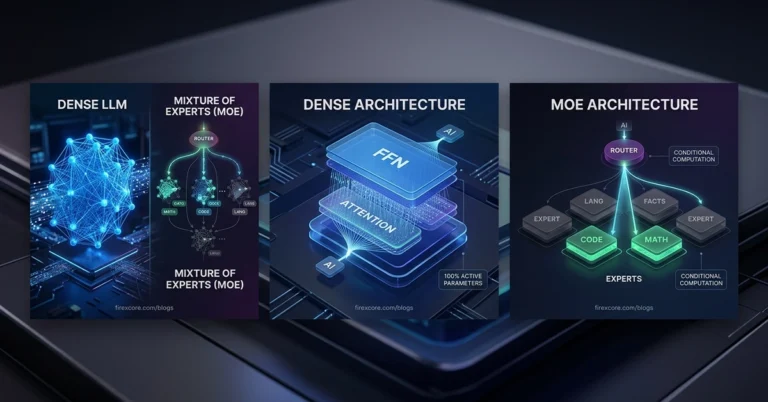
SYMBOLIC-MOE: Revolutionizing AI with Adaptive Expert Mixing
Imagine a team of brilliant minds, each a specialist in their field, coming together to solve complex problems with unmatched precision. Now, picture that team as a group of artificial intelligence models, dynamically recruited for their unique strengths. That’s the promise of SYMBOLIC-MOE, a groundbreaking framework introduced by researchers from UNC Chapel Hill on March 15, 2025. This innovative Mixture-of-Experts (MoE) approach is reshaping how we harness the power of large language models (LLMs). In this article, we’ll dive into what SYMBOLIC-MOE is, how it works, and why it’s a game-changer for AI applications in 2025 and beyond.
What is SYMBOLIC-MOE?
A New Era of AI Collaboration
Large language models like GPT-4o or Llama have dazzled us with their versatility, but even the best all-rounders have their limits. Some excel at math, others at medical reasoning, and a few shine in common-sense tasks. Enter SYMBOLIC-MOE—a symbolic, text-based, gradient-free framework designed to mix pre-trained LLM experts adaptively at the instance level. Unlike traditional MoE models that blend parameters during training, SYMBOLIC-MOE combines the symbolic outputs of specialized models during inference, creating a dynamic “dream team” for every problem.
Why It Matters
Think of it like this: if you’re tackling a geometry puzzle, you don’t need a linguistics expert—you need a math whiz. SYMBOLIC-MOE identifies the skills required for a task and recruits the right LLMs from a pool of 16 models, ranging from algebra wizards to biomedical reasoning champs. The result? An 8.15% average performance boost over the best multi-agent baselines, as demonstrated across benchmarks like MMLU-Pro, AIME, and MedMCQA.
How SYMBOLIC-MOE Works
The Three-Stage Magic
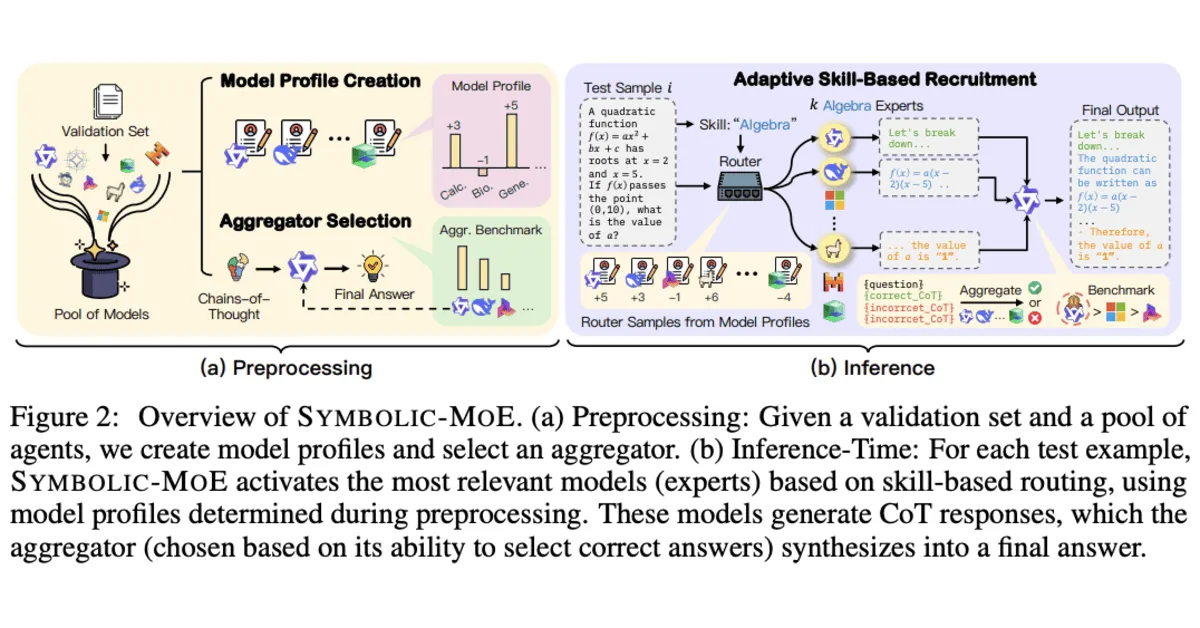
SYMBOLIC-MOE operates in three seamless stages:
- Model Profiling & Aggregator Selection: First, it assesses each LLM’s strengths—think of it as a talent scout sizing up players for the big game. An aggregator model is chosen to oversee the process.
- Expert Recruitment: Using a skill-based strategy, it handpicks the best experts for the task at hand, whether it’s solving equations or analyzing medical data.
- Final Answer Generation: The recruited experts collaborate, and their outputs are combined into a single, high-quality response.
Efficiency Through Batching
Here’s where it gets clever. SYMBOLIC-MOE batches tasks by analyzing all inputs upfront, grouping them by required expertise. This means each expert model is loaded just once, processing its batch in one go. On a single GPU, it runs 44% faster than competing frameworks like Mixture-of-Agents (MoA), all while delivering superior accuracy.
SYMBOLIC-MOE in Action: Performance Highlights
Outperforming the Giants
The numbers don’t lie. SYMBOLIC-MOE has crushed it across diverse benchmarks:
- MMLU-Pro: 8.28% improvement over baselines.
- AIME: A whopping 13.45% boost, outshining even Llama3.3 70B.
- MedMCQA: 6.08% better than multi-agent rivals.
- GPQA: 4.92% edge over the competition.
What’s more, it achieves this with four 7-8B parameter models, matching or beating behemoths with 70B parameters. It’s like a lightweight boxer knocking out a heavyweight champ!
Real-World Applications
From education to healthcare, SYMBOLIC-MOE’s adaptability shines. Imagine a student struggling with algebra getting tailored help from a math-specialized LLM, or a doctor consulting a biomedical expert model for a tricky diagnosis. This framework’s ability to zero in on niche skills makes it a powerhouse for specialized AI applications.
The Edge Over Traditional AI Frameworks
Beyond Sparse MoE and Multi-Agent Systems
Traditional Sparse MoE (SMoE) models activate a subset of experts per input, but they require joint training. Multi-agent systems like MoA or debate frameworks refine answers through collaboration, yet they lack SYMBOLIC-MOE’s fine-grained skill focus. By contrast, SYMBOLIC-MOE’s symbolic mixing and batching strategy deliver unmatched efficiency and precision without human intervention.
A Scalable Future
With support for 16 LLMs—and the option to scale up with more GPUs—SYMBOLIC-MOE is built for growth. As AI demands soar in 2025, this framework could redefine automation, machine learning, and domain-specific problem-solving.
Limitations and Challenges
No system’s perfect, right? SYMBOLIC-MOE’s reliance on multiple models hikes inference costs, which could be a hurdle for budget-conscious users. Plus, its skill profiles depend on a small validation set, potentially missing edge cases. Still, its performance gains make it a worthy trade-off for many.
Key Takeaways and What’s Next
SYMBOLIC-MOE isn’t just another AI buzzword—it’s a leap forward in adaptive intelligence. By blending specialized LLMs with surgical precision, it’s setting a new standard for accuracy and efficiency. Whether you’re a developer, researcher, or just an AI enthusiast, this framework offers a glimpse into a future where machines collaborate as seamlessly as humans.
Ready to dive deeper? Share your thoughts on SYMBOLIC-MOE in the comments below.
Frequently asked questions.
Answers connected directly to this article and its subject.
01 What is SYMBOLIC-MOE?
SYMBOLIC-MOE is a Mixture-of-Experts framework that adaptively mixes pre-trained LLMs based on their specialized skills for specific tasks.
02 How does SYMBOLIC-MOE improve performance?
It outperforms baselines by 8.15% on average by recruiting the best LLMs for each problem and optimizing inference with batching.
03 What are SYMBOLIC-MOE’s main applications?
It excels in education (e.g., math tutoring), healthcare (e.g., medical reasoning), and other domains requiring niche expertise.
04 Is SYMBOLIC-MOE scalable?
Yes, it supports 16 LLMs on a single GPU and can scale with additional hardware for broader use.
05 What are its limitations?
Higher inference costs and reliance on small validation sets for skill profiling are its main drawbacks.