- IBM Granite 3.3: Revolutionizing Enterprise AI with Speech, Reasoning, and Retrieval
- What is IBM Granite 3.3?
- Key Features of Granite 3.3
- Why Granite 3.3 Stands Out in Enterprise AI
- Technical Deep Dive: How IBM Granite 3.3 Works
- The Future of Enterprise AI with Granite 3.3
- Conclusion: Why You Should Care About Granite 3.3
IBM Granite 3.3: Revolutionizing Enterprise AI with Speech, Reasoning, and Retrieval
Imagine a world where your business can transcribe multilingual meetings with pinpoint accuracy, solve complex mathematical problems effortlessly, and retrieve critical data in real-time—all powered by a single AI model. That’s the promise of IBM’s Granite 3.3, a groundbreaking release that’s redefining enterprise AI. Released on April 18, 2025, Granite 3.3 brings cutting-edge advancements in speech-to-text (STT), automatic speech translation (AST), logical reasoning, and retrieval-augmented generation (RAG). In this article, we’ll dive into what makes Granite 3.3 a game-changer, explore its technical innovations, and uncover why it’s a must-have for businesses in 2025.
What is IBM Granite 3.3?
IBM Granite 3.3 is a suite of open-source foundation models designed to meet the evolving needs of enterprises. Unlike traditional AI models that often prioritize one capability at the expense of others, Granite 3.3 excels in three critical areas: speech processing, logical reasoning, and retrieval mechanisms. Whether you’re a tech giant streamlining operations or a startup building innovative applications, IBM Granite 3.3 offers the flexibility, efficiency, and transparency you need.
Why does this matter? Businesses today face increasing pressure to integrate AI that’s not only powerful but also adaptable and transparent. Proprietary models can be restrictive, while open-source alternatives often lack the domain-specific finesse required for enterprise tasks. IBM Granite 3.3 bridges this gap, offering a modular, open-source solution that’s ready to tackle real-world challenges.
Key Features of Granite 3.3
- Granite Speech 3.3 8B: A state-of-the-art STT and AST model that outperforms Whisper-based systems in transcription accuracy and translation quality.
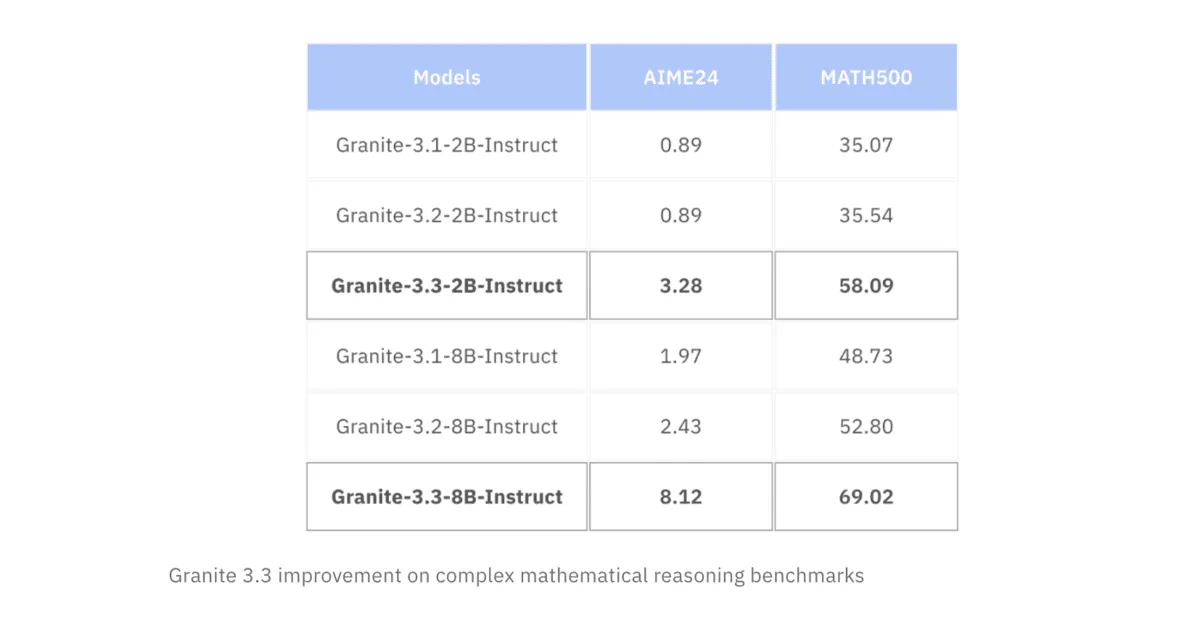
- Granite 3.3 8B Instruct: Enhanced reasoning capabilities, including fill-in-the-middle (FIM) text generation and superior performance on symbolic and mathematical tasks.
- Retrieval-Augmented Generation (RAG): Advanced LoRA and adaptive LoRA (aLoRA) adapters for seamless integration of external knowledge, reducing latency and memory usage.
- Open-Source Accessibility: Available via Hugging Face and deployable on platforms like IBM’s watsonx.ai, Ollama, LMStudio, and Replicate.
Why Granite 3.3 Stands Out in Enterprise AI
The AI landscape is crowded, so what makes Granite 3.3 special? It’s all about addressing the pain points enterprises face—fragmented toolchains, high computational costs, and limited adaptability. Let’s break down how Granite 3.3 delivers.
- Next-Level Speech Processing
Granite Speech 3.3 8B is IBM’s first open STT and AST model, and it’s a powerhouse. It handles long audio sequences with ease, delivering higher transcription accuracy and better translation quality than Whisper-based systems. Whether you’re transcribing a multilingual conference call or translating customer feedback in real-time, this model ensures clarity and coherence.
Example: A global retailer used Granite Speech 3.3 to transcribe and translate customer service calls across 10 languages, reducing manual processing time by 40% and improving response accuracy.
- Smarter Reasoning Capabilities
Granite 3.3 8B Instruct takes reasoning to new heights. It supports fill-in-the-middle generation, making it ideal for tasks like document editing and code completion. Plus, it outperforms competitors like Llama 3.1 8B and Claude 3.5 Haiku on the MATH500 benchmark, proving its prowess in symbolic and mathematical reasoning.
Statistic: Granite 3.3 Instruct achieved a 15% higher accuracy on the MATH500 dataset compared to Llama 3.1 8B, showcasing its edge in complex problem-solving.
Suggested Visual: A video demo of Granite 3.3 solving a mathematical equation step-by-step (Alt text: “Granite 3.3 solving MATH500 problem for enterprise AI”).
- Optimized Retrieval with aLoRA
Retrieval-augmented generation is a hot topic in AI, and Granite 3.3 nails it with its LoRA and adaptive LoRA (aLoRA) adapters. These tools enhance factual accuracy and contextual relevance by integrating external knowledge seamlessly. aLoRA’s ability to reuse the key-value (KV) cache slashes memory consumption and latency, making it perfect for dynamic, data-heavy environments.
Example: A financial firm used IBM Granite 3.3’s RAG capabilities to retrieve and summarize market reports in real-time, cutting analysis time by 30%.
Technical Deep Dive: How IBM Granite 3.3 Works
Granite 3.3’s modular architecture is its secret sauce. Here’s a closer look at its technical foundations:
- Speech Encoder and LoRA Adapters: The speech model uses a speech encoder paired with LoRA-based audio adapters, enabling efficient fine-tuning for specific domains while maintaining broad generalization.
- Fill-in-the-Middle Generation: The Instruct model supports FIM tasks, allowing seamless text insertion for applications like code completion or document editing.
- Adaptive LoRA (aLoRA): By reusing the KV cache, aLoRA reduces computational overhead, making it ideal for streaming or multi-hop retrieval tasks.
- Benchmark Performance: Granite Speech 3.3 8B excels in transcription and translation across multiple languages, while the Instruct model shines in symbolic reasoning tasks.
This architecture ensures Granite 3.3 is both powerful and efficient, addressing the technical fragmentation that often plagues enterprise AI deployments.
The Future of Enterprise AI with Granite 3.3
As AI continues to evolve, models like Granite 3.3 are paving the way for smarter, more efficient enterprise solutions. With its open-source availability and robust performance, IBM Granite 3.3 is poised to drive innovation across industries—from healthcare to finance to customer service.
Trend: According to a 2025 Gartner report, 70% of enterprises will adopt open-source AI models by 2027, driven by the need for transparency and cost-efficiency.
Conclusion: Why You Should Care About Granite 3.3
IBM Granite 3.3 isn’t just another AI model—it’s a blueprint for the future of enterprise AI. With its unparalleled speech processing, advanced reasoning, and optimized retrieval, it’s built to solve real-world challenges while keeping costs and complexity in check. Whether you’re looking to streamline operations, enhance customer experiences, or push the boundaries of innovation, Granite 3.3 is your ticket to staying ahead in 2025.
Ready to supercharge your business with IBM Granite 3.3?
Frequently asked questions.
Answers connected directly to this article and its subject.
01 What is IBM Granite 3.3?
Granite 3.3 is a suite of open-source AI models by IBM, excelling in speech-to-text, automatic speech translation, reasoning, and retrieval-augmented generation.
02 How does Granite Speech 3.3 compare to Whisper?
Granite Speech 3.3 8B offers higher transcription accuracy and better translation quality than Whisper-based systems, especially for long audio sequences.
03 What is aLoRA in Granite 3.3?
Adaptive LoRA (aLoRA) is a memory-efficient retrieval mechanism that reuses the key-value cache, reducing latency in RAG workflows.
04 Is Granite 3.3 open-source?
Yes, Granite 3.3 models and tools are openly available via Hugging Face.
05 What platforms support Granite 3.3?
Granite 3.3 can be deployed on IBM’s watsonx.ai, Ollama, LMStudio, and Replicate.