- Introduction: The Dawn of Personalized AI Systems
- The Challenge of Traditional Multi-Agent Systems
- FlowReasoner: The Next Evolution in Multi-Agent Systems
- Rigorous Evaluation and Impressive Results
- Generalization Capabilities Across Different Models
- The Future of Personalized AI Systems
- Conclusion: A New Paradigm in AI System Design
Introduction: The Dawn of Personalized AI Systems
In the rapidly evolving landscape of artificial intelligence, multi-agent systems have emerged as powerful frameworks driving innovations across chatbots, code generation, mathematical reasoning, and robotics. These complex systems, characterized by planning capabilities, reasoning mechanisms, tool utilization, and memory functions, have traditionally required extensive manual design—creating significant bottlenecks in scalability and resource allocation. Now, a groundbreaking research collaboration between Sea AI Lab, the University of Chinese Academy of Sciences (UCAS), the National University of Singapore (NUS), and Shanghai Jiao Tong University (SJTU) is changing the game with FlowReasoner, an advanced query-level meta-agent that automatically generates personalized systems for individual user needs.
The Challenge of Traditional Multi-Agent Systems
Manual Design Limitations
Traditional LLM-based multi-agent systems have been hindered by their reliance on manual design processes. This approach not only demands substantial human resources but also significantly restricts scalability potential. As applications grow more complex, the limitations of hand-crafted systems become increasingly apparent, highlighting the urgent need for automated solutions.
Previous Automation Attempts
Various approaches have attempted to address these challenges. Graph-based methods sought to automate workflow designs by conceptualizing workflows as networks. However, their structural complexity ultimately limited scalability. Meanwhile, state-of-the-art approaches have represented multi-agent systems as programming code, utilizing advanced LLMs as meta-agents to optimize workflows.
Despite these advances, most solutions focus on task-level optimization, generating single task-specific systems that follow a one-size-fits-all philosophy. This approach fundamentally lacks the capability for automatic adaptation to individual user queries—a critical limitation in real-world applications.
FlowReasoner: The Next Evolution in Multi-Agent Systems
What Makes FlowReasoner Revolutionary?
FlowReasoner represents a paradigm shift in how multi-agent systems are created and deployed. As a query-level meta-agent, it’s designed specifically to automate the creation of query-level multi-agent systems, generating a customized system for each unique user query rather than applying generic solutions across entire categories of tasks.
Technical Foundations
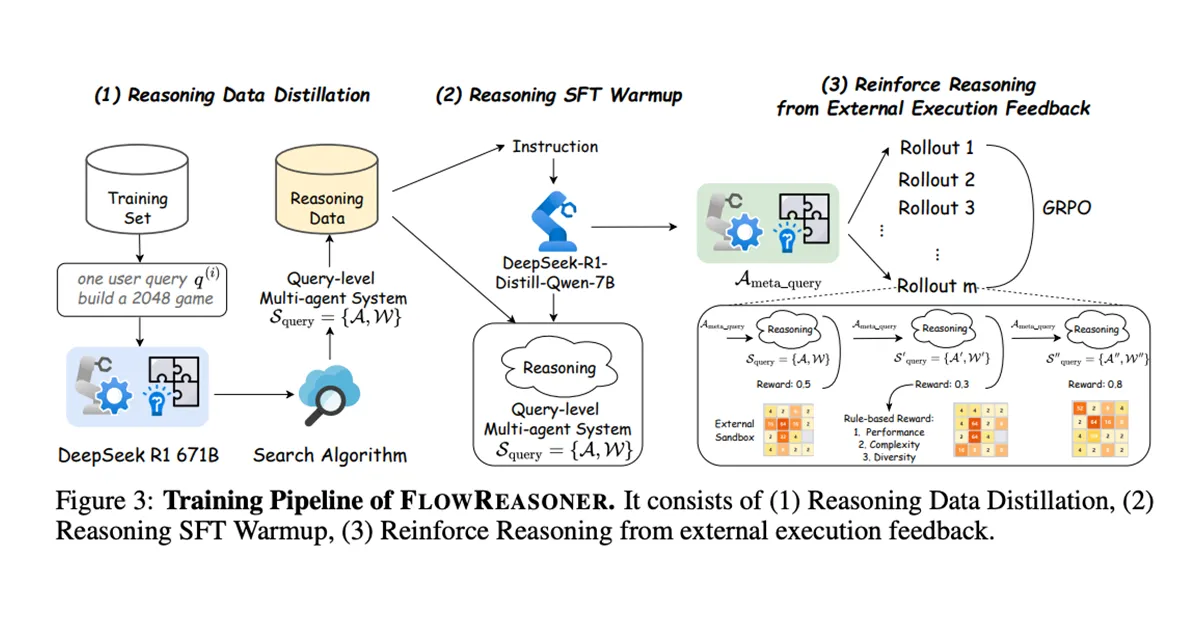
The research team developed FlowReasoner through a sophisticated process of distillation and enhancement. They first distilled DeepSeek R1 to provide FlowReasoner with fundamental reasoning capabilities necessary for creating multi-agent systems. These capabilities were then significantly enhanced through reinforcement learning with external execution feedback.
Multi-Purpose Reward Mechanism
One of the most innovative aspects of FlowReasoner is its multi-purpose reward mechanism, carefully engineered to optimize training across three critical dimensions:
- Performance: Ensuring the system delivers accurate and relevant results
- Complexity: Managing the intricacy of the generated systems to prevent unnecessary bloat
- Efficiency: Optimizing resource utilization and response times
This sophisticated approach enables Flow Reasoner to generate personalized multi-agent systems through deliberative reasoning tailored to each unique query—establishing a new benchmark in adaptive AI system generation.
Rigorous Evaluation and Impressive Results
Comprehensive Testing Framework
To validate FlowReasoner’s capabilities, the research team conducted extensive evaluations across diverse scenarios. They selected three comprehensive datasets:
- BigCodeBench: For engineering-oriented tasks
- HumanEval: For algorithmic challenges
- MBPP: For additional algorithmic testing
These datasets provided a robust foundation for assessing performance across varied code generation scenarios.
Competitive Baseline Comparisons
FlowReasoner was evaluated against three categories of baselines:
- Single-model direct invocation: Using standalone LLMs
- Manually designed workflows: Including Self-Refine, LLM-Debate, and LLM-Blender with human-crafted reasoning strategies
- Automated workflow optimization methods: Such as Aflow, ADAS, and MaAS that construct workflows through search or optimization
For testing, both o1-mini and GPT-4o-mini were employed as worker models for manually designed workflows. Flow Reasoner itself was implemented with two variants of DeepSeek-R1-Distill-Qwen (7B and 14B parameters) using o1-mini as the worker model.
Superior Performance Metrics
The results were remarkable. FlowReasoner-14B outperformed all competing approaches, achieving an overall improvement of 5 percentage points compared to the strongest baseline, MaAS. Even more impressively, it exceeded the performance of its underlying worker model, o1-mini, by a substantial margin of 10%.
These results conclusively demonstrate the effectiveness of Flow Reasoner’s workflow-based reasoning framework in enhancing code generation accuracy.
Generalization Capabilities Across Different Models
Cross-Model Transferability
To assess generalization capabilities, the research team conducted experiments replacing the o1-mini worker with alternative models, including:
- Qwen2.5-Coder
- Claude
- GPT-4o-mini
Throughout these tests, the meta-agent remained fixed as either FLOWREASONER-7B or FLOWREASONER-14B. The system exhibited remarkable transferability, maintaining consistent performance across different worker models on identical tasks.
The Future of Personalized AI Systems
Broader Implications for AI Development
FlowReasoner represents a significant advancement in the evolution of AI systems. By enabling the automatic generation of personalized multi-agent systems for individual queries, it dramatically reduces human resource costs while enhancing scalability. This approach allows for more adaptive and efficient systems that dynamically optimize their structure based on specific user needs rather than relying on fixed workflows for entire task categories.
Potential Applications and Industries
The potential applications for FlowReasoner span numerous industries and use cases, including:
- Software Development: Creating personalized code generation assistants
- Customer Service: Developing query-specific support systems
- Research Assistance: Generating customized research tools based on specific inquiries
- Education: Creating personalized tutoring systems adapted to individual student questions
Conclusion: A New Paradigm in AI System Design
FlowReasoner marks a pivotal moment in the evolution of multi-agent systems. By automating the creation of personalized AI systems at the query level, it overcomes fundamental limitations that have long constrained traditional approaches. Its sophisticated use of external execution feedback and reinforcement learning with multi-purpose rewards enables the generation of optimized workflows without relying on complex search algorithms or carefully designed search sets.
As AI continues to integrate more deeply into our daily lives and work processes, solutions like Flow Reasoner that can adapt to individual needs will become increasingly valuable. The ability to dynamically generate customized systems for specific queries represents not just an incremental improvement but a fundamental rethinking of how we approach AI system design.
Explore how FlowReasoner could revolutionize your AI implementation strategy—contact us today to learn more about personalized multi-agent technologies.
Frequently asked questions.
Answers connected directly to this article and its subject.
01 What is FlowReasoner?
FlowReasoner is a query-level meta-agent designed to automate the creation of personalized multi-agent systems for individual user queries, rather than applying generic solutions across entire task categories.
02 How does FlowReasoner differ from previous approaches?
Unlike previous approaches that focus on task-level solutions, FlowReasoner generates customized systems for each unique query, enabling greater personalization and adaptability.
03 What technologies power FlowReasoner?
FlowReasoner was developed by distilling DeepSeek R1 and enhancing it through reinforcement learning with external execution feedback. It utilizes a multi-purpose reward mechanism optimizing for performance, complexity, and efficiency.
04 How significant are FlowReasoner's performance improvements?
FlowReasoner-14B outperformed the strongest baseline by 5 percentage points and exceeded its underlying worker model by 10%, demonstrating substantial improvements in code generation accuracy.
05 What are the practical applications of FlowReasoner?
FlowReasoner can be applied across various domains including software development, customer service, research assistance, and education—anywhere personalized AI systems would provide enhanced user experiences.