- Xiaomi MiMo-7B: The Compact AI Revolutionizing Math and Coding
- The Rise of Reasoning in AI
- Variants of Xiaomi MiMo-7B
- The Innovation Behind MiMo-7B’s Success
- Benchmark Performance: MiMo-7B vs. Industry Leaders
- Real-World Applications of Xiaomi MiMo-7B
- Challenges and Future Opportunities
- Conclusion: Redefining AI with Compact Intelligence
Xiaomi MiMo-7B: The Compact AI Revolutionizing Math and Coding
Introduction: Small Model, Big Impact
What if a compact AI model could outsmart its larger rivals in solving complex math problems and writing flawless code? In 2025, Xiaomi’s MiMo-7B is doing just that, challenging the notion that bigger models are always better. With just 7 billion parameters, this reasoning-focused language model is making waves by surpassing industry heavyweights like OpenAI’s o1-mini and DeepSeek’s 32B models. From tackling graduate-level math to debugging intricate algorithms, MiMo-7B is proving that intelligence lies in strategy, not scale. Curious about how Xiaomi achieved this feat? Let’s dive into the details of this AI revolution!
Xiaomi, a global leader in consumer electronics, has entered the AI arena with MiMo-7B, a family of language models designed to excel in reasoning-heavy tasks. Unlike traditional large language models (LLMs) that rely on massive parameter counts, Xiaomi MiMo-7B delivers exceptional performance in mathematics and programming with a leaner architecture. Its compact size makes it ideal for deployment in resource-constrained environments, such as edge devices, while its open-source availability fosters innovation across industries.
The Rise of Reasoning in AI
Reasoning is the holy grail of modern AI. Tasks like multi-step mathematical proofs, algorithmic design, and software debugging require logical planning, adaptability, and precision—skills once thought exclusive to human intelligence. As industries demand AI systems that can assist researchers, developers, and educators, models like MiMo-7B are stepping up to meet these challenges. By focusing on reasoning, Xiaomi MiMo-7B positions itself as a domain-specific problem solver rather than a general-purpose conversational tool.
Variants of Xiaomi MiMo-7B
The MiMo-7B family includes several variants, each optimized for specific use cases:
- MiMo-7B-Base: The foundational model, trained from scratch with a reasoning-centric dataset.
- MiMo-7B-SFT: Enhanced through supervised fine-tuning for improved accuracy and robustness.
- MiMo-7B-RL: The flagship model, optimized with reinforcement learning for superior math and coding performance.
- MiMo-7B-RL-Zero: A cold-start RL variant that performs impressively without pre-fine-tuned initialization.
The Innovation Behind MiMo-7B’s Success
MiMo-7B’s remarkable performance stems from a meticulously designed training pipeline that balances pre-training, post-training, and high-quality data. Here’s a deep dive into the key components that make this model a standout.
Pre-Training: Crafting a Reasoning Foundation
The journey begins with pre-training, where MiMo-7B-Base was trained on a colossal dataset of 25 trillion tokens. Xiaomi adopted a three-stage data mixture strategy to prioritize reasoning-heavy content:
- Stage 1: Broad Foundation: Initial training included diverse web data, with a focus on extracting math equations and code snippets using a custom HTML extraction tool. This preserved structural elements critical for problem-solving.
- Stage 2: Reasoning Focus: The dataset was refined to include 70% math and programming content, sourced from academic papers, textbooks, and coding repositories. Global deduplication using URL-based and MinHash techniques ensured data quality.
- Stage 3: Synthetic Boost: An additional 10% of high-quality synthetic reasoning data, generated by advanced models, was introduced to enhance the model’s ability to handle complex problems.
To further optimize pre-training, Xiaomi introduced:
- Multiple-Token Prediction (MTP): An auxiliary objective that predicts several tokens ahead, improving both performance and inference speed.
- Extended Context Length: The model supports up to 32,768 tokens, enabling it to process long-form reasoning tasks, such as multi-step proofs or extensive codebases.
- Quality Filtering: Small language models fine-tuned for content quality replaced outdated heuristic filters, preserving valuable reasoning examples.
This rigorous pre-training approach ensured Xiaomi MiMo-7B was steeped in logical patterns from the outset, setting the stage for its post-training success.
Post-Training: Refining with Reinforcement Learning
Post-training is where Xiaomi MiMo-7B truly differentiates itself. Xiaomi curated a dataset of 130,000 verifiable math and programming problems, each annotated with difficulty scores. This dataset was used in a reinforcement learning (RL) phase that employed a difficulty-driven reward framework to provide nuanced feedback.
Key innovations in post-training include:
- Test Difficulty Driven Reward: Unlike fixed template-based rewards prone to hacking, this system assigns fine-grained scores based on problem complexity, addressing sparse reward issues in coding benchmarks.
- Seamless Rollout Engine: A custom infrastructure incorporating asynchronous reward computation and early termination mechanisms reduced GPU idle time, accelerating RL training by 2.29 times and validation by 1.96 times.
- Data Re-Sampling: To maintain training stability, easy problems were reintroduced with low probability, enhancing rollout sampling efficiency and preventing overfitting.
These strategies enabled MiMo-7B-RL to learn effectively, even in cold-start scenarios, making it a versatile model for real-world applications.
Infrastructure: Powering Efficiency
Xiaomi’s investment in training infrastructure was critical to MiMo-7B’s success. The seamless rollout engine optimized GPU utilization, while advanced data pipelines ensured high-quality inputs. By rethinking every stage of the training process, from data extraction to reward computation, Xiaomi created a model that maximizes performance while minimizing resource demands.
Benchmark Performance: MiMo-7B vs. Industry Leaders
Xiaomi MiMo-7B’s performance in 2025 benchmarks is nothing short of extraordinary. It consistently outperforms larger models and specialized systems, demonstrating the power of its optimized architecture. Here’s a closer look at its achievements:
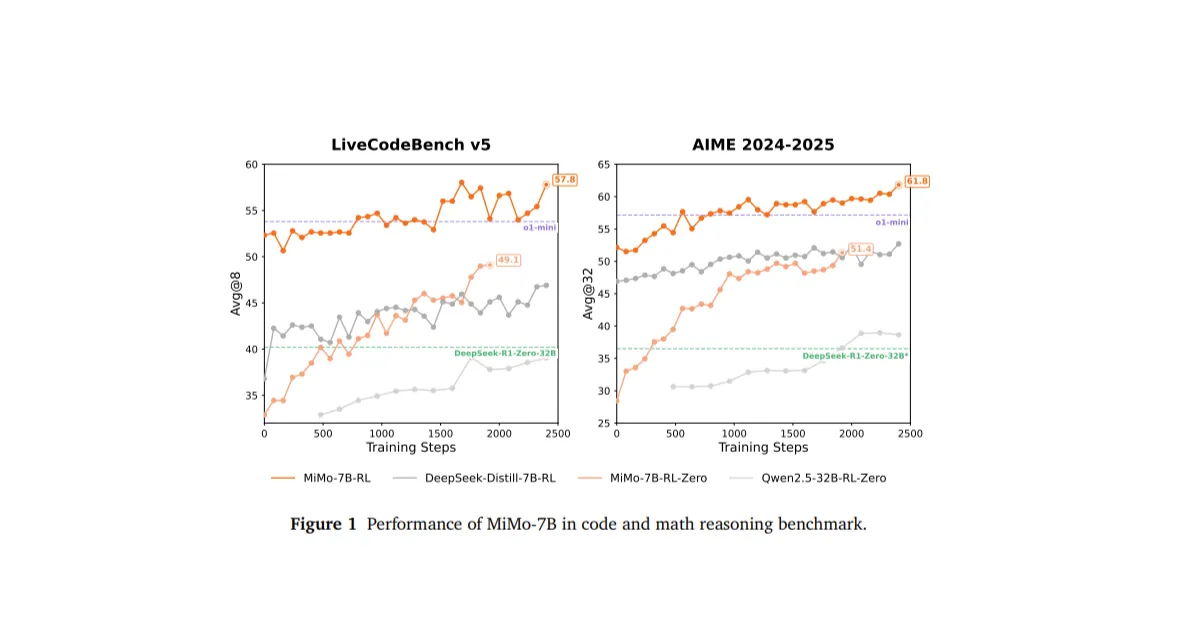
- AIME 2025 (Math): MiMo-7B-RL scored 55.4, surpassing OpenAI’s o1-mini by 4.7 points and beating Alibaba’s 32B QwQ-Preview.
- LiveCodeBench v5 (Coding): Achieved a 57.8% Pass@1 score, outperforming DeepSeek-R1-Zero-32B and Qwen2.5-32B-RL-Zero.
- LiveCodeBench v6: Continued to excel with a 54.2% Pass@1, showcasing robustness across benchmark versions.
- MATH-500: Hit 95.8% accuracy on the first attempt, setting a new standard for compact models.
- Big-Bench Hard (BBH): MiMo-7B-Base scored 75.2, outpacing other open-source 7B models.
- SuperGPQA: Demonstrated strong performance on graduate-level reasoning questions, rivaling larger models.
These results highlight Xiaomi MiMo-7B’s ability to deliver high accuracy and consistency in reasoning tasks, making it a compelling alternative to resource-intensive models.
Real-World Applications of Xiaomi MiMo-7B
MiMo-7B’s compact size and reasoning prowess open up a wide range of applications across industries. Here are some key use cases:
- Education: Assisting students with step-by-step math problem-solving and coding tutorials, enhancing learning outcomes.
- Software Development: Automating code debugging, algorithm optimization, and unit test generation for faster development cycles.
- Research: Supporting automated theorem proving, logical analysis, and data-driven hypothesis testing in academic settings.
- Edge Computing: Enabling reasoning tasks on resource-constrained devices, such as IoT systems or mobile platforms.
- Enterprise Solutions: Powering intelligent automation in industries like finance, healthcare, and logistics, where logical decision-making is critical.
By open-sourcing Xiaomi MiMo-7B under an Apache 2.0 license, Xiaomi has made it accessible to developers worldwide. You can download the model from Hugging Face or explore its checkpoints on GitHub.
Challenges and Future Opportunities
While Xiaomi MiMo-7B is a breakthrough, it’s not without challenges. Balancing math and coding performance during RL training can be tricky, as over-optimization in one domain may degrade the other. Additionally, the model occasionally produces unintended language mixing (e.g., Chinese output in English tasks), which requires further refinement.
These challenges present exciting opportunities for the AI community. Xiaomi’s open-source approach invites researchers and developers to contribute improvements, potentially addressing these issues and unlocking new capabilities. Future iterations could focus on:
- Domain-Specific Fine-Tuning: Creating specialized variants for math, coding, or other reasoning tasks.
- Multilingual Robustness: Enhancing language consistency across diverse contexts.
- Energy Efficiency: Optimizing inference for even lower power consumption on edge devices.
Conclusion: Redefining AI with Compact Intelligence
Xiaomi’s MiMo-7B is a testament to the power of innovation over scale. By combining a reasoning-focused dataset, advanced pre-training, and cutting-edge reinforcement learning, this 7-billion-parameter model is rewriting the rules of AI performance. Its open-source availability and compact design make it a catalyst for progress in education, software development, research, and beyond. As the AI community rallies around Xiaomi MiMo-7B, the possibilities are endless. Ready to harness its potential? Visit Hugging Face to download Xiaomi MiMo-7B and join the reasoning revolution!
Frequently asked questions.
Answers connected directly to this article and its subject.
01 What is Xiaomi MiMo-7B?
MiMo-7B is a 7-billion-parameter AI model designed for reasoning tasks, excelling in math and coding, and outperforming larger models like OpenAI’s o1-mini.
02 How does MiMo-7B compare to other AI models?
It scores 55.4 on AIME 2025 (4.7 points above o1-mini) and 57.8% on LiveCodeBench v5, surpassing 32B models like QwQ-Preview.
03 Is MiMo-7B open-source?
Yes, it’s available under an Apache 2.0 license on Hugging Face and GitHub, including base, SFT, RL, and RL-Zero variants.
04 What makes MiMo-7B unique?
Its three-stage pre-training, multiple-token prediction, and difficulty-driven RL rewards enable exceptional reasoning in a compact model.
05 Can MiMo-7B run on edge devices?
Its small size makes it suitable for resource-constrained environments, ideal for enterprise and edge computing applications.