OlympicCoder: The Future of AI in Competitive Programming
Competitive programming has long been a battleground for showcasing algorithmic prowess, logical reasoning, and efficient problem-solving skills. However, despite advancements in AI-driven code generation, many existing models struggle with the complexity of olympiad-level programming. Hugging Face aims to change this narrative with the introduction of OlympicCoder, a cutting-edge AI model designed specifically to handle the intricacies of high-stakes programming contests.
In this article, we explore how OlympicCoder is transforming the landscape of competitive programming, the technical advancements it brings, and what this means for both AI researchers and programmers.
The Challenges in AI-Based Code Generation
AI-generated code has seen remarkable improvements in recent years, but when it comes to competitive programming, existing models often fall short due to:
- Inability to maintain long chain-of-thought reasoning
- Difficulty in solving complex, multi-layered problems
- Struggles with generalization beyond simplified test cases
- Lack of exposure to high-quality competitive programming datasets
Many traditional AI models generate solutions that might pass basic test cases but fail in real competition scenarios. This gap between AI-generated code and human-level reasoning prompted Hugging Face to develop OlympicCoder, an AI model capable of tackling the toughest programming challenges with a structured and logical approach.
Introducing OlympicCoder
Hugging Face recently unveiled OlympicCoder, a series of AI models fine-tuned to excel in olympiad-level programming challenges. This model lineup includes:
- OlympicCoder-7B – A mid-sized model designed for structured reasoning and optimized training efficiency.
- OlympicCoder-32B – A larger, more powerful model that rivals closed-source frontier models.
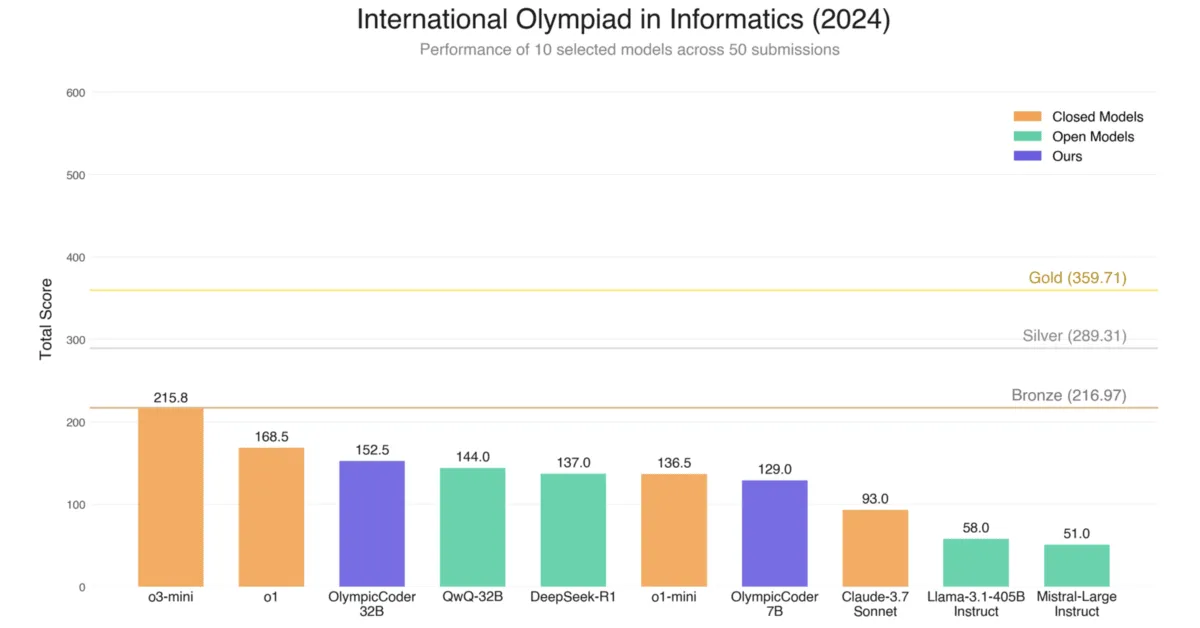
Both models were trained on CodeForces-CoTs, a dataset containing nearly 100,000 high-quality chain-of-thought (CoT) samples. The result? OlympicCoder has outperformed proprietary AI models like Claude 3.7 Sonnet on International Olympiad in Informatics (IOI) problems, proving that open-source models can compete with and even surpass their closed-source counterparts.
Technical Advancements of OlympicCoder
-
High-Quality Dataset Curation
One of the key differentiators of OlympicCoder is its use of CodeForces-CoTs, a meticulously curated dataset that captures the complexity of real-world competitive programming problems. Unlike traditional AI models that rely on fragmented datasets, OlympicCoder benefits from:
- Comprehensive problem statements
- Multiple correct solutions for each problem
- Detailed explanations supporting logical reasoning
-
Optimized Training Approach
OlympicCoder is built on Qwen2.5-Coder Instruct and has undergone a unique training regimen that prioritizes long-context reasoning. Key innovations include:
- No sample packing – Ensuring that solutions remain fully intact without truncation.
- Higher learning rate (4e-5) – Allowing the model to fine-tune its reasoning capabilities.
- Cosine learning rate scheduler – Improving generalization and optimization across various problem types.
These refinements enable OlympicCoder to outperform existing models in scenarios where logical depth and step-by-step problem-solving are critical.
-
Benchmarking and Performance
The performance of OlympicCoder was rigorously tested on benchmarks such as LiveCodeBench and IOI 2024 problems. Unlike conventional AI models that rely on single-shot answers, OlympicCoder adopts a more human-like submission strategy, where:
- Multiple solutions are generated for each problem.
- The most coherent chain-of-thought reasoning is prioritized.
- Real competition conditions are simulated.
Results showed that OlympicCoder-32B consistently outperforms even some of the most sophisticated closed-source AI models, demonstrating the effectiveness of its advanced training techniques.
What This Means for the Future of AI in Coding
-
Open-Source AI Can Compete with Proprietary Models
The success of OlympicCoder reinforces the idea that open-source AI models can match and even exceed the performance of proprietary AI. This development is particularly important for democratizing AI research, allowing programmers and researchers to build upon an already powerful framework.
-
Enhanced AI-Assisted Coding for Developers
Developers can now leverage OlympicCoder for:
- Training for coding competitions (e.g., CodeForces, IOI, ACM-ICPC).
- Learning advanced problem-solving techniques through AI-generated explanations.
- Exploring multiple solution approaches for a given problem.
-
Future Improvements and Expansions
While OlympicCoder is already a game-changer, future iterations could incorporate:
- Support for additional programming languages beyond Python and C++.
- Integration with interactive coding platforms for real-time feedback.
- Enhanced debugging capabilities to assist developers in refining AI-generated solutions.
- More diverse training datasets to improve generalization across different programming paradigms.
- Collaborative coding features allowing AI-human co-programming for real-time assistance.
Conclusion
OlympicCoder marks a significant milestone in AI-driven competitive programming. By addressing the limitations of previous models and incorporating state-of-the-art techniques, it paves the way for a new era of AI-assisted problem-solving. Whether you’re a seasoned competitive programmer or an AI researcher, OlympicCoder presents exciting possibilities for the future of AI in algorithmic reasoning and code generation.
Frequently asked questions.
Answers connected directly to this article and its subject.
01 What is OlympicCoder?
OlympicCoder is an AI model developed by Hugging Face, designed to solve complex olympiad-level programming problems using chain-of-thought reasoning.
02 How is OlympicCoder different from other AI code generators?
Unlike traditional code-generation models, OlympicCoder excels in long-context reasoning, leveraging a highly curated dataset to improve its problem-solving accuracy.
03 Can OlympicCoder be used for learning competitive programming?
Yes! Programmers can use OlympicCoder to analyze AI-generated solutions, understand advanced techniques, and improve their coding contest skills.
04 What benchmarks has OlympicCoder been tested on?
OlympicCoder has been evaluated using LiveCodeBench and IOI 2024 problems, where it outperformed several closed-source models.
05 Is OlympicCoder open-source?
Yes, Hugging Face has made OlympicCoder open-source, allowing developers and researchers to explore and expand upon its capabilities.