- Stanford FramePack: Revolutionary AI Framework Solving Long Video Generation Challenges
- The Twin Challenges of Video Generation
- Stanford FramePack: A Breakthrough Architecture
- Anti-Drifting Techniques: Reversing the Problem
- <strong>Real-World Performance and Integration</strong>
- Implications for the Future of AI Video Generation
- Conclusion: A Foundation for the Next Generation of AI Video
Stanford FramePack: Revolutionary AI Framework Solving Long Video Generation Challenges
Introduction: The Evolution of Video Generation
Video generation has emerged as one of artificial intelligence’s most compelling frontiers, promising to transform everything from content creation to visual storytelling. However, generating high-quality, coherent videos—especially longer sequences—has remained a significant challenge due to computational limitations and visual inconsistencies. Stanford researchers have developed a groundbreaking framework called FramePack that addresses these core issues through innovative compression techniques and sampling strategies.
This article explores how Stanford FramePack works, why it represents a major advancement in video generation technology, and what its implications are for the future of AI-generated video content.
The Twin Challenges of Video Generation
Understanding Drifting and Forgetting
One of the most persistent obstacles in video generation has been maintaining visual consistency across frames. As AI models generate videos frame by frame, two primary issues emerge: “drifting” and “forgetting.”
Drifting occurs when errors in early frames propagate and amplify throughout the sequence, causing visible deterioration in quality. This cascading effect becomes increasingly problematic as video length increases.
Forgetting happens when models lose track of elements from initial frames, leading to inconsistencies in motion, character appearance, or scene structure as the video progresses.
The Computational Bottleneck
Attempts to solve these problems often create new challenges. Increasing a model’s memory capacity to maintain coherence can accelerate error propagation, while reducing reliance on previous frames might limit consistency. This fundamental tension has stymied progress in long-form video generation.
Traditional approaches have included noise scheduling, augmentation methods, anchor-based planning, and architectural innovations like sparse attention mechanisms. Despite these advances, the field has lacked a unified, computationally efficient solution capable of balancing memory requirements with error control.
Stanford FramePack: A Breakthrough Architecture
Hierarchical Compression System
Stanford FramePack introduces a hierarchical compression system that prioritizes frames based on their temporal importance. The architecture assigns higher resolution to recent frames (considered more relevant to maintaining coherence) while progressively downsampling older frames.
This innovative approach solves a fundamental problem: In standard video diffusion models, each 480p frame generates approximately 1,560 tokens of context. For a sequence with 100 input frames and one predicted frame, the context length could exceed 157,000 tokens—making computation practically impossible.
Progressive Compression Schedule
The heart of Stanford FramePack’s design is its progressive compression schedule. The system applies a geometric progression (typically using a parameter λ=2) to reduce context length for each earlier frame by half. For example, the most recent frame might use full resolution, the next one half resolution, then a quarter, and so on.
This elegant solution ensures that total context length remains within a fixed limit regardless of input video length, effectively removing the context length bottleneck that has constrained previous models.
Implementation Through 3D Patchifying Kernels
Stanford FramePack implements its compression using 3D patchifying kernels—such as (2,4,4), (4,8,8), and (8,16,16)—which control how frames are broken into smaller patches before processing. These kernels are trained with independent parameters to stabilize learning.
For extremely long input sequences, low-importance tail frames are either dropped, minimally included, or globally pooled to avoid unnecessary computational overhead. This flexible approach enables FramePack to manage videos of arbitrary length efficiently.
Anti-Drifting Techniques: Reversing the Problem
Bi-Directional Context Utilization
Beyond compression, Stanford FramePack incorporates innovative anti-drifting sampling techniques that fundamentally reimagine how video frames are generated. Rather than producing frames in strict sequential order, the system utilizes bi-directional context by generating anchor frames—particularly the beginning and end of a sequence—before interpolating the content between them.
This approach provides stable reference points that help maintain visual consistency throughout the entire video.
Inverted Temporal Sampling
Perhaps most revolutionary is Stanford FramePack’s inverted sampling variant, which reverses the traditional generation order. Instead of producing frames from start to finish, this technique begins with the last known high-quality frame and works backward.
This inverted approach has proven especially effective for image-to-video generation tasks, where a static image serves as the foundation for generating a complete motion sequence. By anchoring on high-quality user input frames, the system maintains exceptional visual fidelity.
Real-World Performance and Integration
Proven Computational Efficiency
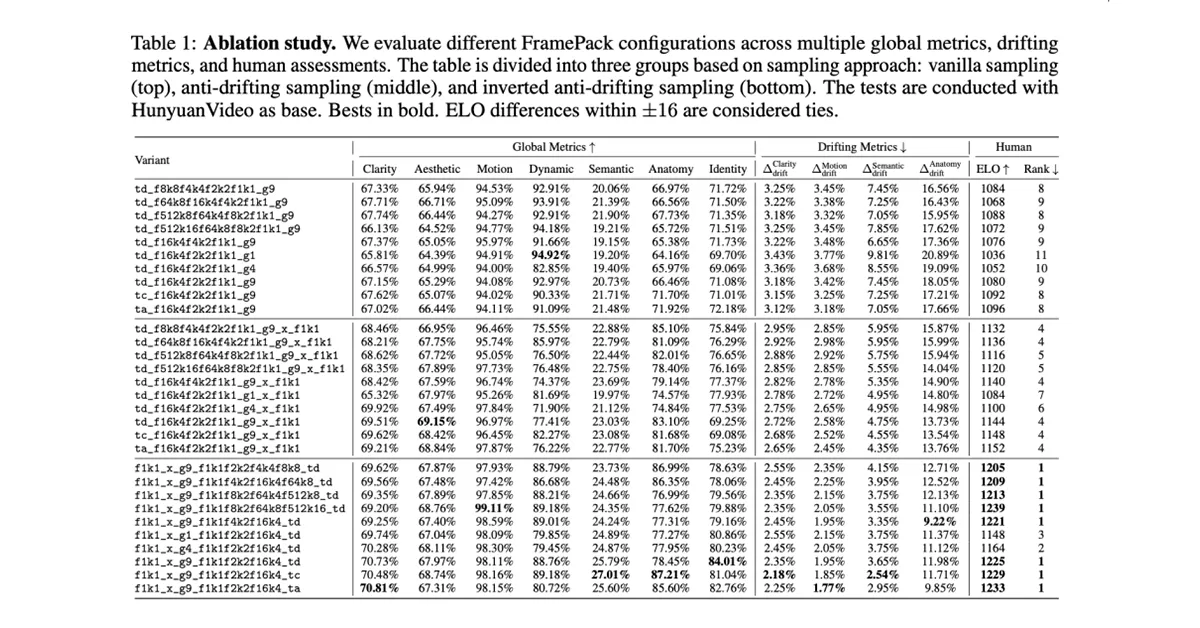
Performance metrics demonstrate Stanford FramePack’s practical value in real-world applications. When integrated into pretrained diffusion models like HunyuanVideo and Wan, the framework significantly reduced memory usage per generation step while enabling larger batch sizes—approaching scales commonly used in image diffusion training.
This efficiency gain represents a substantial advance in making video generation more accessible and practical.
Enhanced Visual Quality
The anti-drifting techniques substantially improved visual quality across generated videos. By reducing the diffusion scheduler’s aggressiveness and balancing shift timesteps, models demonstrated fewer artifacts and greater frame-to-frame coherence.
Notably, the inverted sampling approach resulted in better approximation of known frames, enabling high-fidelity generation when a target image is specified.
Plug-and-Play Flexibility
One of Stanford FramePack’s most practical advantages is its ability to enhance existing architectures without requiring complete retraining. These improvements occurred without additional training from scratch, demonstrating the framework’s adaptability as a plug-in enhancement for current video generation systems.
Implications for the Future of AI Video Generation
Democratizing Long-Form Video Creation
Stanford FramePack’s efficiency innovations could democratize access to high-quality video generation. By dramatically reducing computational requirements, the technology may soon enable longer, more complex AI-generated videos on more modest hardware—potentially bringing these capabilities to individual creators and smaller organizations.
Applications Across Industries
The technology has promising applications across multiple sectors:
- Entertainment: Generating longer, more coherent animations and visual effects
- Education: Creating instructional videos with consistent characters and settings
- Marketing: Producing customized video content at scale
- Gaming: Developing dynamic cutscenes and responsive visual narratives
Future Research Directions
While Stanford FramePack represents a significant breakthrough, it also opens new avenues for research:
- Integration with audio generation for complete audiovisual experiences
- Further refinement of compression techniques for even greater efficiency
- Exploration of additional sampling strategies for specific use cases
- Development of user interfaces that leverage these capabilities for non-technical creators
Conclusion: A Foundation for the Next Generation of AI Video
Stanford FramePack addresses the fundamental challenges of next-frame video generation through progressive input compression and modified sampling strategies. By maintaining fixed context lengths, implementing adaptive patchifying, and pioneering innovative sampling approaches, the framework successfully preserves both memory efficiency and visual clarity across extended sequences.
As video content continues to dominate digital communication, technologies like Stanford FramePack will become increasingly crucial. By solving the core technical challenges that have limited AI video generation, Stanford’s researchers have laid a foundation for more sophisticated, accessible, and practical video creation tools.
The days of short, inconsistent AI-generated clips may soon give way to coherent, high-quality videos of arbitrary length—opening new possibilities for creators, businesses, and communicators worldwide.
Explore how Stanford FramePack could transform your creative or business video projects – contact us to learn about implementing this cutting-edge technology.
Frequently asked questions.
Answers connected directly to this article and its subject.
01 What is FramePack and how does it improve video generation?
FramePack is an AI framework developed by Stanford researchers that uses progressive compression and innovative sampling techniques to generate longer, more consistent videos while reducing computational requirements.
02 What problems does FramePack solve in video generation?
FramePack addresses two major challenges: “drifting” (propagation of errors across frames) and “forgetting” (loss of visual consistency with earlier frames) while maintaining computational efficiency.
03 How does FramePack's compression system work?
It applies a hierarchical compression schedule that assigns higher resolution to recent frames while progressively downsampling older frames, following a geometric progression that typically halves resolution for each earlier frame.
04 What makes FramePack's sampling approach unique?
FramePack uses bi-directional context by generating anchor frames (like the beginning and end) first, then filling in between. It also offers inverted temporal sampling that works backward from a high-quality target frame.
05 Can FramePack be integrated with existing video generation models?
Yes, FramePack can be implemented as a plug-in enhancement to pretrained diffusion models without requiring complete retraining, making it highly adaptable to existing architectures.