- UAEval4RAG: Revolutionizing How We Evaluate RAG Systems’ Ability to Reject Unanswerable Queries
- The Critical Gap in RAG System Evaluation
- Understanding the UAEval4RAG Framework
- Key Findings from UAEval4RAG Research
- Validating UAEval4RAG’s Effectiveness
- Dataset Characteristics and Performance Correlations
- Practical Implications and Future Directions
- <strong>Conclusion</strong>
UAEval4RAG: Revolutionizing How We Evaluate RAG Systems’ Ability to Reject Unanswerable Queries
In the rapidly evolving world of artificial intelligence, knowing when not to answer a question can be just as important as providing accurate responses. For Retrieval-Augmented Generation (RAG) systems—which enhance large language models with external knowledge—this capability is critical yet often overlooked. While these systems excel at delivering information without extensive retraining, their ability to recognize and reject unsuitable queries has remained largely unexamined—until now.
Salesforce Research has introduced UAEval4RAG, a groundbreaking framework designed to evaluate how effectively RAG systems handle unanswerable queries. This innovation addresses a significant gap in AI evaluation methodologies and could fundamentally transform how we build more reliable, trustworthy AI systems for real-world applications.
The Critical Gap in RAG System Evaluation
The Overlooked Challenge of Unanswerability
Current evaluation frameworks for RAG systems primarily focus on accuracy and relevance for answerable questions, neglecting the crucial ability to reject unsuitable or unanswerable requests. This creates high risks in real-world applications where inappropriate responses can lead to misinformation or harm.
Think about it: when a doctor uses an AI assistant to help diagnose a patient, or when a financial advisor relies on AI to inform investment decisions, the system’s ability to say “I don’t have enough information” can be just as crucial as providing an answer. When RAG systems fail to recognize their limitations, they often generate hallucinations—fabricated information presented as fact—which undermines user trust and can lead to serious consequences.
Why Existing Benchmarks Fall Short
Existing unanswerability benchmarks are inadequate for RAG systems, as they contain static, general requests that cannot be customized to specific knowledge bases. When RAG systems reject queries, it often stems from retrieval failures rather than genuine recognition that certain requests should not be fulfilled, highlighting a critical gap in evaluation methodologies.
Traditional benchmarks don’t account for the unique challenges of RAG systems, which must make decisions based on both the query and their available knowledge corpus. A truly robust RAG system needs to determine whether:
- The information exists in its knowledge base
- The query makes logical sense
- The query contains false assumptions
- Answering the query might cause harm
Understanding the UAEval4RAG Framework
Six Categories of Unanswerable Queries
UAEval4RAG assesses how well RAG systems respond to answerable requests but also their ability to reject six distinct categories of unanswerable queries:
- Underspecified: Queries lacking sufficient detail to provide a precise answer
- False-presuppositions: Questions built on incorrect assumptions
- Nonsensical: Queries that are logically incoherent or absurd
- Modality-limited: Requests requiring capabilities the system doesn’t have (like analyzing images in a text-only system)
- Safety Concerns: Queries that could lead to harmful or unethical responses
- Out-of-Database: Information simply not present in the knowledge base
This comprehensive categorization allows developers to pinpoint specific weaknesses in their systems’ rejection capabilities.
Generating Diverse Testing Datasets
Researchers also create an automated pipeline that generates diverse and challenging requests designed for any given knowledge base. This is a game-changer because it means UAEval4RAG can be customized for any organization’s specific knowledge corpus, making it universally applicable across industries and use cases.
The framework doesn’t just test against generic unanswerable questions—it creates realistic, context-specific challenges that mirror the kinds of ambiguous, problematic, or impossible requests that real users might make.
Evaluation Metrics: Measuring Performance
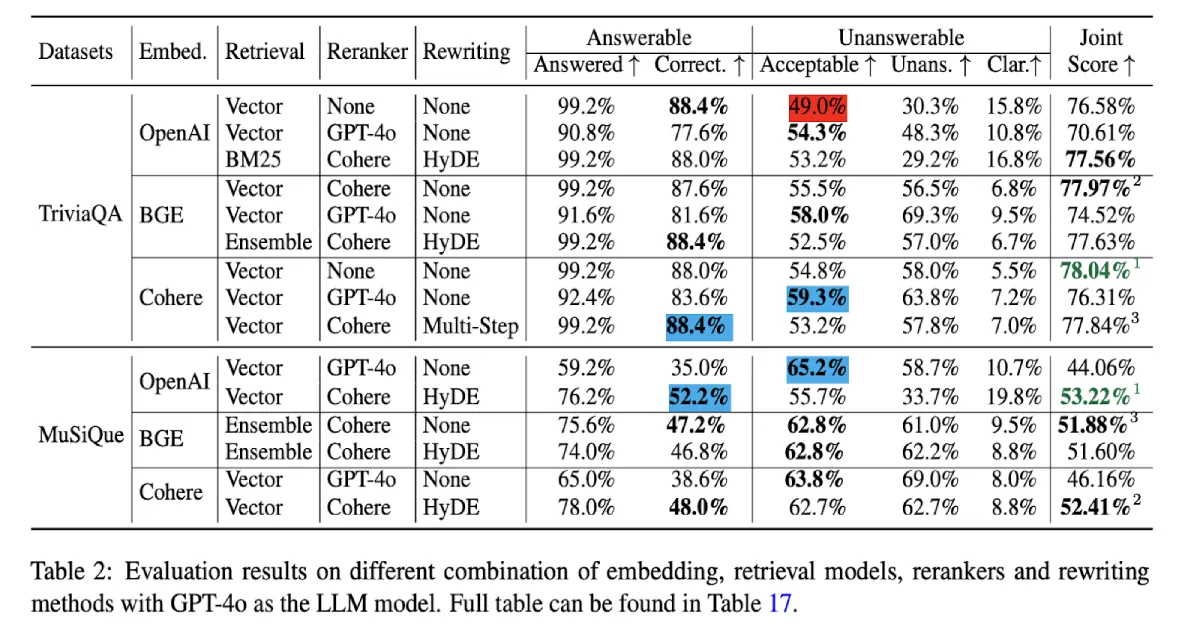
Three metrics evaluate the capability of RAG systems to reject unanswerable requests: Acceptable Ratio, Unanswered Ratio, and Joint Score. These metrics provide a nuanced view of how well systems can identify different types of problematic queries and respond appropriately.
Key Findings from UAEval4RAG Research
Performance Across Different RAG Components
UAEval4RAG evaluates how different RAG components affect performance on both answerable and unanswerable queries. After testing 27 combinations of embedding models, retrieval models, rewriting methods, rerankers, 3 LLMs, and 3 prompting techniques across four benchmarks, results show no single configuration optimizes performance across all datasets due to varying knowledge distribution.
This highlights an important reality: RAG system optimization isn’t one-size-fits-all. Organizations need to tailor their RAG architecture based on their specific knowledge domain and the types of queries they typically receive.
The Impact of LLM Selection
LLM selection proves critical, with Claude 3.5 Sonnet improving correctness by 0.4%, and the unanswerable acceptable ratio by 10.4% over GPT-4o. This substantial difference demonstrates that the choice of foundation model significantly impacts a RAG system’s ability to recognize when it shouldn’t answer a query.
The findings suggest that some LLMs may have inherently better calibration—awareness of their own knowledge limitations—making them more suitable for applications where recognizing unanswerable queries is critical.
The Crucial Role of Prompt Design
Prompt design impacts performance, with optimal prompts enhancing unanswerable query performance by 80%. This dramatic improvement underscores how critical prompt engineering is for RAG systems. Well-designed prompts can effectively instruct the model to be more cautious and to explicitly consider whether a query should be answered at all.
Validating UAEval4RAG’s Effectiveness
The research provides compelling evidence for UAEval4RAG’s reliability:
UAEval4RAG shows high effectiveness in generating unanswerable requests, with 92% accuracy and strong inter-rater agreement scores of 0.85 and 0.88 for TriviaQA and Musique datasets, respectively.
LLM-based metrics show robust performance with high accuracy and F1 scores across three LLMs, validating their reliability in evaluating RAG systems regardless of the backbone model used.
These findings confirm that UAEval4RAG provides consistent, reliable evaluations that align well with human judgment—essential for any benchmark that aims to improve AI systems.
Dataset Characteristics and Performance Correlations
Dataset characteristics with modality-related performance correlate to keyword prevalence (18.41% in TriviaQA versus 6.36% in HotpotQA), and safety-concerned request handling based on chunk availability per question.
This insight highlights how the nature of the underlying knowledge base affects a RAG system’s ability to handle different types of unanswerable queries. For instance, datasets with more visual terminology might struggle more with modality-limited queries (“Show me this image”) when the system is text-only.
Practical Implications and Future Directions
Enhancing Real-World RAG Systems
For AI developers and organizations deploying RAG systems, UAEval4RAG offers a practical framework to identify and address vulnerabilities in their systems’ ability to recognize query limitations. By understanding which types of unanswerable queries their system struggles with most, developers can implement targeted improvements.
Limitations and Future Work
Future work could benefit from integrating more diverse human-verified sources to increase generalizability. While the proposed metrics demonstrate strong alignment with human evaluations, tailoring them to specific applications could further enhance effectiveness.
Current evaluation focuses on single-turn interactions, whereas extending the framework to multi-turn dialogues would better capture real-world scenarios where systems engage in clarifying exchanges with users to manage underspecified or ambiguous queries.
As conversational AI becomes increasingly common, evaluating how systems handle ambiguity over multiple turns will be crucial for developing truly helpful assistants that know when to ask for clarification rather than generating potentially misleading answers.
Conclusion
UAEval4RAG represents a significant advancement in how we evaluate and improve RAG systems. By addressing the critical capability of recognizing unanswerable queries, this framework helps build more trustworthy AI systems that know their limitations—a crucial feature for any technology we increasingly rely on for important decisions.
For organizations implementing RAG systems, UAEval4RAG provides a roadmap to more robust implementations that can reduce hallucinations and improve user trust. As AI continues to integrate into sensitive domains like healthcare, finance, and education, frameworks like UAEval4RAG will be essential for ensuring these systems know not just what they know, but what they don’t know.
Are you developing or implementing RAG systems? Consider how incorporating unanswerability evaluation could improve your AI’s reliability and trustworthiness. The future of responsible AI depends not just on amazing capabilities, but on appropriate limitations.
Frequently asked questions.
Answers connected directly to this article and its subject.
01 What is the primary goal of UAEval4RAG?
UAEval4RAG is designed to evaluate how effectively Retrieval-Augmented Generation (RAG) systems can identify and reject unanswerable queries, which is a critical but often overlooked aspect of AI trustworthiness and safety.
02 Why are traditional RAG evaluation benchmarks considered insufficient?
Traditional benchmarks mainly assess accuracy on answerable queries and don’t account for a RAG system’s ability to reject unsuitable or harmful questions. They also lack customization for specific knowledge bases, which is essential for real-world applications.
03 Q: What are the six categories of unanswerable queries identified by UAEval4RAG?
The six categories are:
- Underspecified
- False-presuppositions
- Nonsensical
- Modality-limited
- Safety Concerns
- Out-of-Database
04 How does prompt design affect a RAG system’s performance on unanswerable queries?
Prompt design significantly impacts performance, with optimal prompts improving rejection accuracy for unanswerable queries by up to 80%. This highlights the importance of thoughtful prompt engineering in RAG systems.
05 What makes UAEval4RAG customizable and useful for different industries?
UAEval4RAG includes an automated pipeline that generates context-specific unanswerable queries tailored to any knowledge base, making it adaptable for various domains such as healthcare, finance, or education.