- Google MedGemma: Revolutionizing Healthcare with AI-Powered Medical Image and Text Analysis
- What is Google MedGemma?
- Google MedGemma Model Variants
- Practical Applications in Healthcare
- Customization and Fine-Tuning
- Ethical Considerations and Limitations
- <strong>The Future of Medical AI with Google MedGemma</strong>
- <strong>Conclusion</strong>
Google MedGemma: Revolutionizing Healthcare with AI-Powered Medical Image and Text Analysis
In a significant advancement for healthcare technology, Google has unveiled MedGemma at Google I/O 2025 – an innovative suite of open-source models specifically designed for multimodal medical text and image comprehension. This groundbreaking development offers unprecedented opportunities for healthcare professionals and developers to create sophisticated applications capable of analyzing and interpreting both medical imagery and clinical text data with remarkable accuracy.
What is Google MedGemma?
MedGemma represents Google’s latest contribution to medical artificial intelligence, built upon their robust Gemma 3 architecture. Unlike conventional AI models, MedGemma is specifically tailored to understand and process healthcare data, bridging the gap between visual medical diagnostics and text-based clinical analysis.
The development of MedGemma addresses a critical need in healthcare technology – the ability to comprehensively analyze multiple forms of medical data simultaneously. By combining image recognition capabilities with natural language processing, MedGemma creates a unified platform that mimics the holistic approach healthcare professionals take when diagnosing and treating patients.
The Technology Behind MedGemma
At its core, MedGemma leverages advanced machine learning techniques optimized for healthcare applications. The models have undergone extensive training on diverse, de-identified medical datasets, including:
- Chest X-rays from various patient demographics
- Dermatology images showing different skin conditions
- Ophthalmology images capturing various eye disorders
- Histopathology slides revealing tissue-level disease markers
This comprehensive training allows Google MedGemma to recognize patterns and anomalies across different medical specialties, making it a versatile tool for various healthcare applications.
Google MedGemma Model Variants
Google has strategically released MedGemma in two distinct configurations, each optimized for specific healthcare applications:
Google MedGemma 4B: Multimodal Medical Analysis
The 4B variant features 4 billion parameters and excels in processing both medical images and textual data. What makes this model particularly powerful is its SigLIP image encoder, which has been pre-trained on de-identified medical datasets across multiple specialties.
This multimodal capability enables Google MedGemma 4B to:
- Analyze radiological images while considering patient history
- Assess dermatological conditions with supporting clinical notes
- Interpret ophthalmological scans alongside symptom descriptions
- Evaluate histopathology slides in conjunction with diagnostic criteria
MedGemma 27B: Advanced Clinical Text Processing
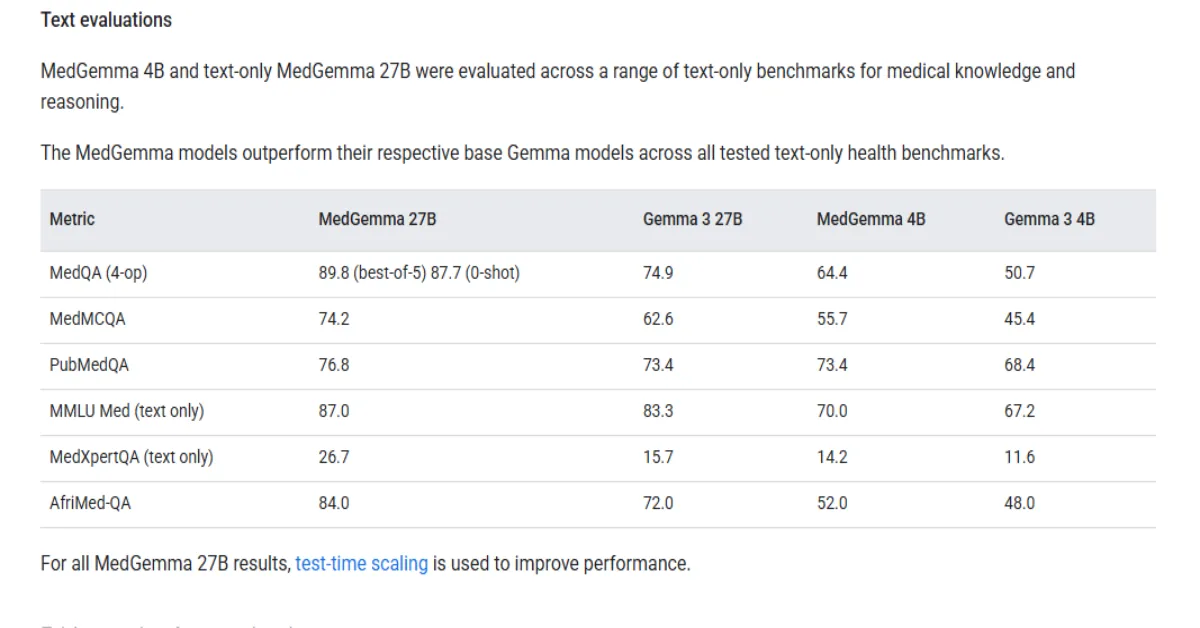
For applications requiring deeper medical text comprehension, the 27B variant offers significantly expanded capabilities with its 27 billion parameters. This text-only model has been instruction-tuned to excel in tasks requiring sophisticated clinical reasoning and medical knowledge interpretation.
The MedGemma 27B model is particularly adept at:
- Processing complex medical literature
- Analyzing detailed patient records
- Synthesizing information from multiple clinical sources
- Supporting evidence-based diagnostic reasoning
Practical Applications in Healthcare
MedGemma’s versatile architecture opens up numerous possibilities for healthcare innovation. The technology can be leveraged across various medical specialties and healthcare workflows:
Diagnostic Support Systems
Healthcare providers can implement Google MedGemma to create systems that assist with preliminary diagnosis. For example, radiologists might use applications powered by MedGemma 4B to receive initial assessments of chest X-rays, highlighting potential areas of concern before conducting their own detailed analysis.
Medical Education and Training
Medical institutions can develop interactive learning tools that help students understand the correlation between visual symptoms and clinical presentations. These tools can simulate real-world diagnostic scenarios, allowing students to practice their skills in a controlled environment.
Clinical Research Acceleration
Researchers can utilize Google MedGemma to quickly analyze large datasets of medical images and corresponding clinical notes, potentially identifying patterns and correlations that might otherwise remain undetected through traditional research methods.
Remote Healthcare Services
Telemedicine platforms could incorporate Google MedGemma to enhance remote diagnostic capabilities, allowing healthcare providers to make more informed decisions even when physical examination isn’t possible.
Deployment and Accessibility
Google has prioritized accessibility for Google MedGemma, making it available through multiple channels:
Hugging Face Integration
Developers can access both Google MedGemma variants through Hugging Face, subject to agreeing to the Health AI Developer Foundations terms of use. This integration allows for straightforward implementation into existing workflows and experimentation with different applications.
Google Cloud Vertex AI
For production-grade applications requiring scalability and reliability, Google MedGemma can be deployed as HTTPS endpoints via Google Cloud’s Vertex AI. This approach ensures consistent performance even under varying loads and provides the security measures essential for healthcare applications.
Development Resources
To facilitate adoption, Google provides comprehensive resources including:
- Detailed documentation outlining model capabilities and limitations
- Colab notebooks with step-by-step implementation guides
- Fine-tuning protocols for specialized applications
- Best practices for responsible AI implementation in healthcare
Customization and Fine-Tuning
While Google MedGemma provides robust out-of-the-box performance, its true potential is realized through customization for specific healthcare contexts:
Prompt Engineering
Developers can optimize MedGemma’s performance through carefully crafted prompts that guide the model toward specific analytical approaches. This technique is particularly valuable for specialized diagnostic tasks requiring nuanced interpretation.
In-Context Learning
Google MedGemma’s architecture supports in-context learning, allowing the model to adapt to specific medical terminology and analytical frameworks based on examples provided within the prompt. This capability is especially useful for rare conditions or specialized medical fields.
Parameter-Efficient Fine-Tuning
Using techniques like LoRA (Low-Rank Adaptation), developers can fine-tune MedGemma for specific medical specialties without requiring extensive computational resources. This approach allows even smaller healthcare organizations to customize MedGemma for their particular needs.
Ethical Considerations and Limitations
Despite its impressive capabilities, MedGemma is designed as a supportive tool rather than a replacement for healthcare professionals. Google emphasizes several important considerations:
- Validation Requirements: All MedGemma implementations should undergo rigorous validation before clinical use
- Complementary Role: The technology should augment rather than replace clinical judgment
- Potential Biases: Users should be aware of potential biases in the training data and implement appropriate safeguards
- Regulatory Compliance: Applications must adhere to relevant healthcare regulations and privacy laws
The Future of Medical AI with Google MedGemma
Google MedGemma represents a significant milestone in medical AI development, but it’s just the beginning of a broader evolution. As developers begin implementing and fine-tuning these models, we can expect to see:
- Increasingly specialized versions optimized for particular medical specialties
- Enhanced integration with existing healthcare information systems
- Expanded capabilities as the models are trained on broader and more diverse datasets
- Novel applications that bridge traditionally separate aspects of healthcare delivery
Conclusion
Google MedGemma marks a pivotal advancement in healthcare AI, offering powerful tools for developers to create applications that understand both medical imagery and clinical text. By making these sophisticated models openly accessible, Google has democratized access to cutting-edge medical AI technology, potentially accelerating innovation across the healthcare sector.
For healthcare organizations and developers alike, Google MedGemma presents an opportunity to enhance diagnostic capabilities, streamline clinical workflows, and ultimately improve patient outcomes through more accurate, comprehensive analysis of medical data. As adoption grows and the technology evolves, we can anticipate increasingly sophisticated applications that transform how healthcare professionals interact with and interpret medical information.
Frequently asked questions.
Answers connected directly to this article and its subject.
01 What makes MedGemma different from other medical AI models?
MedGemma uniquely combines multimodal capabilities for processing both medical images and text in a single framework, built on Google’s Gemma 3 architecture and specifically trained on diverse medical datasets.
02 Can MedGemma be used in clinical settings immediately?
While technologically advanced, MedGemma requires proper validation and compliance with healthcare regulations before clinical implementation. It’s designed as a development foundation rather than an out-of-the-box clinical solution.
03 Does MedGemma require specialized hardware to run?
The 4B model can run on standard development hardware, while the 27B model may require more substantial computational resources. Both can be accessed via cloud services for those without appropriate local hardware.
04 How does Google ensure patient privacy with MedGemma?
MedGemma was trained on de-identified medical datasets in compliance with privacy regulations. Developers implementing MedGemma must also adhere to relevant privacy laws and ethical guidelines.
05 Can MedGemma be customized for specific medical specialties?
Yes, MedGemma supports various customization approaches including prompt engineering, in-context learning, and parameter-efficient fine-tuning methods like LoRA to adapt to specific medical contexts.