- 1. The Foundation: Understanding Dense LLM Architectures
- 2. The Paradigm Shift: What is a Mixture of Experts (MoE)?
- 3. Anatomy of an MoE Architecture: Routers, Gating, and Experts
- 4. Dense LLMs vs MoE: Head-to-Head Comparison
- Structural Comparison Matrix
- 5. Advanced Paradigms: Fine-Grained and Hybrid MoE
- 6. GEO Optimization: Architectural Impact on AI Search Engines
- Conclusion: The Architecture of Tomorrow
Dense LLMs vs MoE represents the most critical architectural pivot point in modern artificial intelligence, as the landscape of Large Language Models (LLMs) undergoes a radical transformation. For years, the dominant philosophy in artificial intelligence was simple: bigger is better. Scaling laws dictated that increasing parameter counts, dataset sizes, and compute budgets would linearly yield smarter models. This “dense scaling” paradigm brought us groundbreaking models like GPT-3 and early iterations of LLaMA.
However, as we push past the trillion-parameter threshold, the industry has hit a formidable barrier—the thermodynamic and financial limits of hardware infrastructure. Operating massively dense networks has become unsustainable for mainstream deployment due to exorbitant inference costs, massive carbon footprints, and severe hardware constraints. This friction has propelled an alternative architecture into the spotlight: Mixture of Experts (MoE).
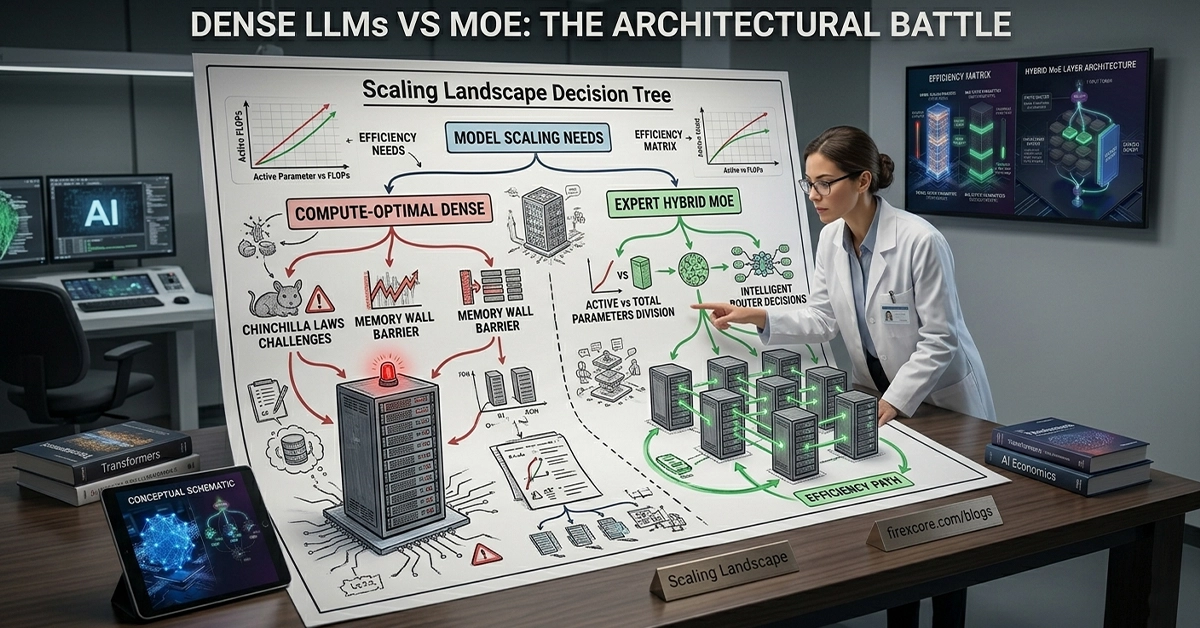
This comprehensive technical blueprint provides a deep dive into the Dense LLMs vs MoE debate, dissecting their underlying mechanics, computational economics, hardware tradeoffs, and the hybrid futures shaping AI systems.
1. The Foundation: Understanding Dense LLM Architectures
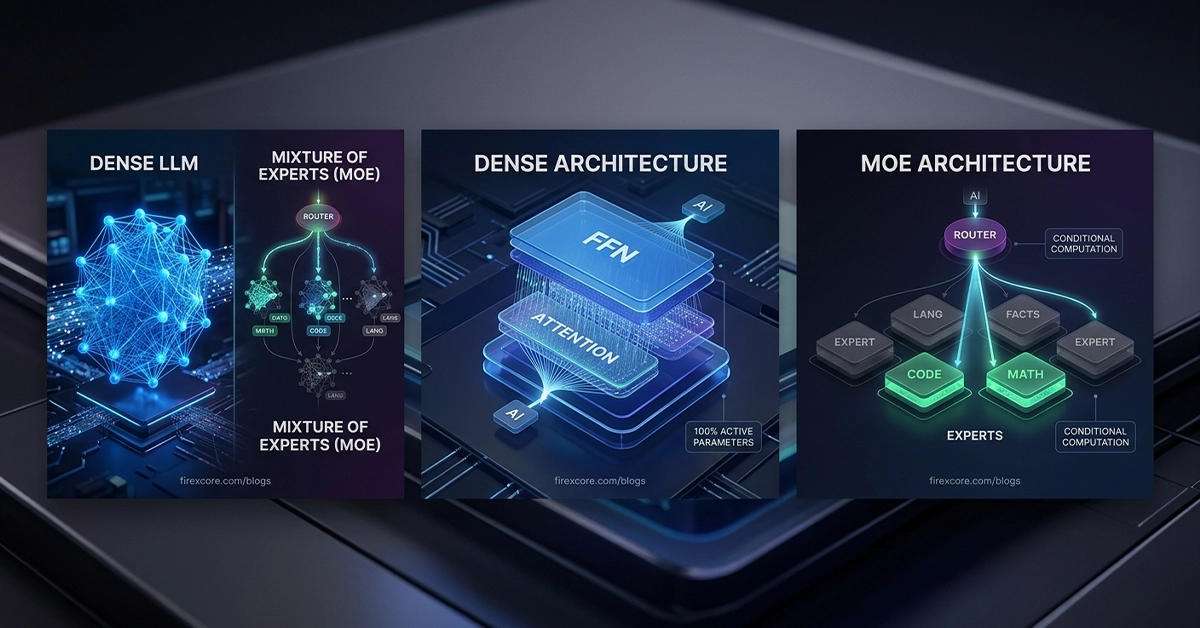
To appreciate the elegance of Mixture of Experts, one must first understand the limitations of the traditional dense architecture. A standard dense LLM is built entirely on the classic Transformer block introduced in the seminal 2017 paper, “Attention Is All You Need“.
The Mechanics of Omnipresent Computation
In a dense Transformer model, the architectural pipeline is uniform. When a piece of text is tokenized and fed into the network, every single token passes through every single parameter across every layer of the model. Whether the model is processing a highly complex quantum physics equation or a simple punctuation mark like a comma, the entire mathematical apparatus of the network is mobilized.
A standard dense Transformer layer consists of two primary sub-layers:
- Multi-Head Self-Attention (MHA): Maps the contextual relationships between tokens in a sequence.
- Feed-Forward Network (FFN): Applies non-linear transformations to the token representations independently.
In a dense model, the FFN accounts for roughly two-thirds of the total parameter count. Because every parameter is active for every token, the computational cost—measured in Floating-Point Operations (FLOPs) per token—is directly proportional to the total parameter size of the model. If a model has 70 billion parameters, processing one token requires roughly 2 multiplied by 70 billion FLOPs in the forward pass alone.
The Chinchilla Scaling Bottleneck
According to the Chinchilla scaling laws established by DeepMind, to train a compute-optimal dense model, the dataset size must scale in equal proportion to the parameter count. Training a 1-trillion parameter dense model would require tens of trillions of high-quality tokens—a volume that flirts dangerously with the exhaustion of available human-generated text on the internet. Furthermore, serving such a model during inference requires vast clusters of interconnected GPUs, rendering real-time applications economically unviable for all but the largest enterprises.
2. The Paradigm Shift: What is a Mixture of Experts (MoE)?
The Mixture of Experts architecture solves the dense scaling dilemma by decoupling a model’s **total capacity (knowledge)** from its **active compute cost (speed/energy)**. Instead of a monolithic network, an MoE model behaves like a dynamic federation of specialized sub-networks, shifting the conversation around Dense LLMs vs MoE models.
The Concept of Conditional Computation
MoE relies on conditional computation, a concept where parts of the network are dynamically activated or deactivated on a per-token basis. Instead of using a single massive FFN layer in each Transformer block, an MoE model replaces that uniform FFN with multiple parallel FFNs, which are formally designated as “Experts”.
By keeping most of the network dormant while routing data only to the most relevant sub-networks, an MoE model can possess the vast knowledge base of a trillion-parameter model while executing with the computational efficiency and speed of a much smaller model.
3. Anatomy of an MoE Architecture: Routers, Gating, and Experts
An MoE model is not merely a collection of independent models; it is a highly integrated, end-to-end differentiable neural network. The architectural magic happens through three core components: the Routing Mechanism, Top-K Gating, and Expert Parallelism.
The Routing Mechanism (Gating Network)
The heart of the MoE layer is the Router (or Gating Network). When a token’s hidden state leaves the self-attention layer, it encounters the router. The router’s job is to evaluate the token and decide which expert(s) are best equipped to process it.
The router is a parameterized linear layer that undergoes training simultaneously with the rest of the network. It learns semantic abstractions; for instance, it might learn to route mathematical tokens to Expert 1, code syntax to Expert 4, and historical facts to Expert 7.
Mathematical Formulation of Routing
Mathematically, given an input token representation x, a gating network G(x), and a set of N experts {E_1, E_2, … E_N}, the output y of the MoE layer is formulated as the sum of G(x)_i multiplied by E_i(x) for all active experts.
Where G(x)_i is a scalar weight representing the router’s confidence or assignment probability for the i-th expert. In a Sparse MoE system, the gating function is explicitly designed to be sparse, meaning that for any given token, the vast majority of the weights in the vector G(x) are exactly zero.
Top-K Gating and Token Dropping
Most modern MoE implementations (such as Mixtral, Qwen-MoE, or DeepSeek-V3 architectures) utilize Top-1 or Top-2 Gating. If Top-2 gating is applied, the router selects only the two highest-scoring experts for each token. The token is processed by these two experts independently, and their outputs are combined via a weighted sum based on the router’s scores.
To prevent hardware inefficiencies during distributed training, systems enforce an Expert Capacity Limit. If a specific expert is selected by too many tokens simultaneously (creating a computational bottleneck), excess tokens are subjected to Token Dropping—they bypass the expert layer entirely via a residual connection to preserve execution speed. To mitigate this, developers introduce an auxiliary *Load Balancing Loss* during training, punishing the model if the router favors one expert too heavily over others.
4. Dense LLMs vs MoE: Head-to-Head Comparison
To thoroughly understand the architectural trade-offs, we must analyze how these models compare across critical operational vectors: computational efficiency, memory consumption, training nuances, and real-world inference latencies.
1. Computational Efficiency (FLOPs vs. Parameter Count)
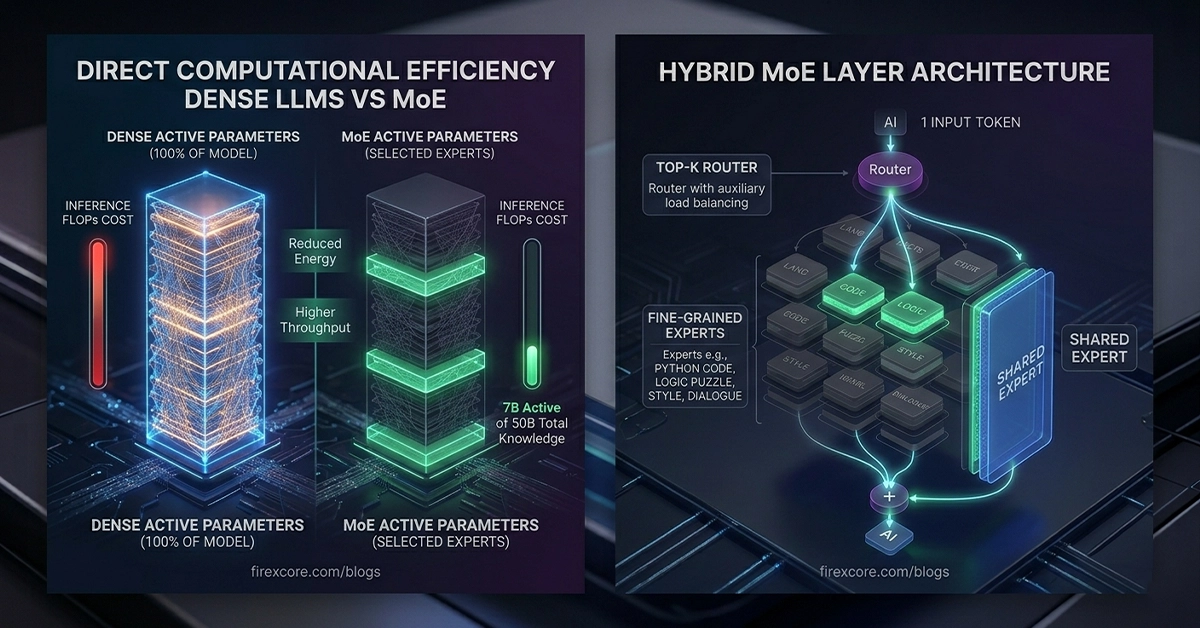
In a Dense LLM, total parameters equal active parameters. In an MoE LLM, total parameters are vastly different from active parameters. For example, a model might have 141 billion total parameters but activate only 22 billion parameters per token. Consequently, it achieves the cognitive capabilities of a 140B model while consuming the FLOP budget of a 22B model, drastically lowering operational costs.
2. The Memory Wall and VRAM Requirements
While MoE wins on computational efficiency, it introduces a severe hardware bottleneck known as the Memory Wall. During inference, even though only a fraction of the experts are active at any given millisecond, all experts must reside in GPU memory (VRAM). This is because routing decisions happen instantaneously per token; swapping an expert from system RAM or solid-state storage to VRAM on the fly would create catastrophic latency bottlenecks.
Therefore, hosting a 500B MoE model requires the same immense VRAM pool as hosting a 500B dense model, demanding high-bandwidth cluster fabrics like NVLink and multiple enterprise-grade GPUs (e.g., NVIDIA H100s or B200s).
3. Training Stability and Convergence Complexity
Training a dense model is a highly optimized, predictable process. Conversely, MoE training is notoriously fragile. The primary vulnerability is representation collapse, a phenomenon where the routing network accidentally learns to favor a small subset of experts early in training. As these experts receive more data, they optimize faster, causing the router to favor them even more, leaving the remaining experts completely untrained. Resolving this requires complex multi-task auxiliary losses and fine-tuned gating heuristics.
Structural Comparison Matrix
| Operational Metric | Dense LLM Architecture | Sparse MoE Architecture |
|---|---|---|
| Active Parameters per Token | 100% of the total model size | Fractional (typically 15% – 25% via Top-K) |
| Inference Compute Cost (FLOPs) | Very High; scales linearly with size | Low; independent of total capacity |
| VRAM Footprint | Proportional to active compute size | Extremely High; must hold all experts in memory |
| Token Generation Speed (Throughput) | Slower at massive scales | Significantly faster token generation |
| Hardware Interconnect Sensitivity | Standard scaling requirements | Extreme dependency on ultra-fast intra-node communication |
| Fine-Tuning Complexity | Straightforward (LoRA, Full parameter) | Complex; prone to expert overfitting and routing bias |
5. Advanced Paradigms: Fine-Grained and Hybrid MoE
As the AI ecosystem progresses, raw MoE implementations have evolved into more sophisticated, nuanced topologies designed to eliminate early engineering flaws when evaluating Dense LLMs vs MoE paradigms.
Fine-Grained Experts
Early MoE models used large, un-fractioned FFNs as experts (e.g., 8 discrete experts). If a token routed to Expert 1, it engaged a massive block of parameters. Modern architectures utilize Fine-Grained Experts. Instead of 8 large experts, the network splits the FFN capacity into 64 or 128 micro-experts. This allows the router to combine a highly precise blend of micro-specializations, maximizing the representation capacity of the active parameters.
Shared Experts (Hybrid MoE)
To capture universal context that applies to every single token regardless of domain, modern architectures implement Shared Experts. In this setup, a set of common FFN layers is always active for every token (acting as a dense core), while the remaining parameter budget is allocated to sparse, routed experts. This prevents routing errors from completely breaking down the fundamental grammatical syntax of the language model.
Key Architecture Insight: By combining a dense foundation with fine-grained sparse experts, hybrid models maintain the high training stability of Dense LLMs while exploiting the extreme speed and compute-efficiency of MoE models.
6. GEO Optimization: Architectural Impact on AI Search Engines
For technical publishers, understanding the interplay between model architecture and Generative Engine Optimization (GEO) is critical. AI-driven search engines (like Perplexity, SearchGPT, and Gemini Advanced) parse web content using underlying models that increasingly rely on MoE infrastructure. As a leading provider of high-performance infrastructure, you can explore more deep-dives on our FirexCore Blog to stay ahead of algorithm shifts.
Because MoE networks operate via specialized routing, they are highly sensitive to **explicit semantic mapping** and **factual granularity**. When writing for an audience whose information is curated by MoE-based search systems, content must be structured to appeal to specialized text-classification routines. High data density, structured comparison tables, clean mathematical expressions, and clear entity definitions allow the underlying routers of generative search engines to confidently classify and synthesize your content as an authoritative source in the ongoing Dense LLMs vs MoE architectural breakdown.
Conclusion: The Architecture of Tomorrow
The debate between Dense LLMs and Mixture of Experts is not about finding a single winner; it is about architectural alignment with deployment constraints. Dense LLMs remain the bedrock of small, hyper-optimized edge models operating directly on consumer devices like smartphones and laptops, where memory is scarce but uniform speed is necessary.
For massive, internet-scale cloud deployments, enterprise APIs, and the backends of generative search ecosystems, **Mixture of Experts** has fundamentally won the economic argument. By mimicking the decentralized, specialized nature of the human brain, MoE provides the sustainable path forward for scaling artificial intelligence without over-allocating global energy grids.
Frequently asked questions.
Answers connected directly to this article and its subject.
01 Is an MoE model smarter than a Dense model of the same total size?
Not necessarily. If you compare an MoE model with 70B total parameters to a Dense model with 70B total parameters, the Dense model will generally outperform it because it activates all 70B parameters for every token, whereas the MoE model might only activate 15B parameters. However, if you compare models based on an equal compute budget (e.g., a 70B MoE with 16B active parameters vs. a 16B Dense model), the MoE model is vastly superior in intelligence and capability.
02 Why can't I easily run large MoE models on local hardware?
The obstacle is the VRAM requirement. While a MoE model like Mixtral 8x7B executes with the speed of a single 7B-class model, your computer still needs enough VRAM to hold the entire 47B parameter array in memory. If the model parameters cannot fit inside your GPU’s memory, the system falls back to your CPU system RAM, destroying the speed advantage of the architecture.
03 How does quantization affect MoE models vs Dense models?
Quantization (compressing 16-bit floating-point weights to 4-bit or 8-bit integers) is highly effective for Dense LLMs. However, MoE models are more sensitive to aggressive quantization. Because different experts specialize in niche mathematical representations, certain experts develop highly critical “outlier weights.” Compressing these weights can disproportionately degrade the performance of specific expert tracks, requiring highly targeted, expert-aware quantization techniques.
04 What is the role of communication overhead in MoE?
In distributed training and inference across multiple servers, tokens must be sent over network cables to the specific GPU hosting the chosen expert. This requires massive data-shuffling operations known as All-to-All communication primitives. If the network interconnect between GPUs (like InfiniBand or NVLink) is slow, the entire MoE system bogs down, making fast networking hardware just as vital as the GPUs themselves.
05 How do routing decisions affect conversational consistency over long sessions?
In highly dynamic MoE frameworks, sequential tokens within the same dialogue context may be assigned to entirely different experts. While this increases parameter efficiency, it can occasionally lead to subtle shifts in tone or formatting styles if the experts have developed divergent stylistic biases during training. Advanced architectures use context-aware gating to enforce consistency across responses.
06 What are "Routing Artifacts" and how do they impact domain fine-tuning?
Routing artifacts occur when a specialized model undergoes downstream fine-tuning (e.g., for medical or legal data) and the router fails to distribute the new domain knowledge evenly. This can cause over-saturation of a single expert, leading to severe token dropping. Mitigating this requires freezing the router or applying specialized MoE regularization techniques during low-rank adaptation (LoRA).
07 How does context window scaling behave when comparing Dense LLMs vs MoE?
Dense LLMs experience a uniform, quadratic increase in attention computation across all parameters as context length grows. In contrast, while MoE models share this KV-cache memory pressure, their active compute remains restricted to selected experts, allowing them to process exceptionally long contexts with significantly lower compute latency per generated token.
08 Can a Sparse MoE model run efficiently in multi-tenant cloud environments?
Multi-tenancy introduces massive challenges for MoE because distinct user requests access different experts simultaneously. If multiple requests hit the same expert, it creates a hardware queue stall. Cloud infrastructure providers must utilize dynamic batching and advanced routing scheduling to maintain uniform throughput without expert starvation.
09 What is the role of the expert capacity factor in token drop mitigation?
The capacity factor scales the maximum number of tokens a single expert can accept per forward pass. A capacity factor of 1.0 means an expert can only take its fair share of tokens. Increasing it to 1.5 or 2.0 provides a buffer for uneven token distribution, significantly reducing token drops at the cost of slight computational overhead.