- Enhancing Large Language Models with Reinforcement Learning: Introducing R1-Searcher
- <strong>The Challenge: LLMs and Knowledge Limitations</strong>
- Introducing R1-Searcher: A Reinforcement Learning-Based Framework
- <strong>Performance and Experimental Results</strong>
- The Future of AI: Reinforcement Learning for Smarter LLMs
- Conclusion: A Step Towards Smarter AI
Enhancing Large Language Models with Reinforcement Learning: Introducing R1-Searcher
Large language models (LLMs) have revolutionized artificial intelligence (AI) by generating human-like text, answering complex queries, and assisting in various fields such as healthcare, finance, and customer service. However, their reliance on pre-trained data often leads to limitations when handling real-time or knowledge-intensive questions. This challenge results in inaccurate responses, outdated information, and even hallucinations—situations where an AI model generates misleading or entirely incorrect answers. To overcome these challenges, researchers have been exploring ways to integrate external search capabilities into LLMs to enhance their accuracy and adaptability.
A recent breakthrough in this field is R1-Searcher, a reinforcement learning-based framework designed to improve LLMs’ ability to retrieve and integrate external knowledge autonomously. Unlike traditional methods that rely on supervised fine-tuning (SFT) or structured prompting, R1-Searcher leverages reinforcement learning (RL) to dynamically refine retrieval strategies, improving response accuracy across diverse datasets. This article explores the core challenges LLMs face, the limitations of existing retrieval methods, and how R1-Searcher is setting a new benchmark for AI search capabilities.
The Challenge: LLMs and Knowledge Limitations
Why Do LLMs Struggle with Real-Time Information?
LLMs are trained on massive datasets, but their knowledge remains static after training. This poses several problems:
- Limited real-time updates: LLMs do not have direct access to evolving information, such as breaking news or recently published research.
- Difficulty in handling domain-specific queries: They struggle with specialized knowledge that wasn’t part of their training data, particularly in fast-changing fields like medicine or law.
- Hallucinations: They sometimes generate incorrect or misleading responses due to over-reliance on incomplete or outdated data, potentially leading to misinformation.
- Computational inefficiency: Performing in-depth reasoning tasks without access to external knowledge often requires extensive fine-tuning and large-scale training, making AI models less practical for real-world applications.
Existing Solutions and Their Shortcomings
Several approaches have been introduced to tackle these issues:
- Retrieval-Augmented Generation (RAG): Enhances responses by incorporating external search results. However, it depends heavily on structured prompts and predefined templates, limiting flexibility.
- Supervised Fine-Tuning (SFT): Trains LLMs on curated datasets, but can lead to overfitting, where models become too dependent on specific training examples rather than generalizing knowledge.
- Iterative Prompting and Tree-Based Search (e.g., Monte Carlo Tree Search – MCTS): These methods improve retrieval but require expensive computational resources and often depend on proprietary models, restricting accessibility.
Given these limitations, a more autonomous, scalable, and efficient retrieval mechanism is required.
Introducing R1-Searcher: A Reinforcement Learning-Based Framework
How Does R1-Searcher Work?
Developed by researchers from Renmin University of China and DataCanvas Alaya NeW, R1-Searcher is designed to enhance LLMs’ retrieval abilities using a two-stage reinforcement learning process:
Phase 1: Learning to Invoke External Search
- The model is trained to recognize when an external search is needed, an essential first step in improving retrieval accuracy.
- It receives retrieval-based rewards for initiating searches effectively, without considering the correctness of the final answer. This encourages the model to explore when and how to search for relevant information.
Phase 2: Answer Optimization and Refinement
- The model refines its search capabilities using answer-based rewards, ensuring that retrieved information contributes meaningfully to answering questions.
- A tailored loss function penalizes unnecessary searches while rewarding optimal information retrieval, striking a balance between search efficiency and accuracy.
By dynamically integrating reasoning and retrieval, R1-Searcher ensures that LLMs can adapt to a wide range of queries without the limitations of traditional fine-tuning.
Performance and Experimental Results
How Does R1-Searcher Compare to Other Methods?
The effectiveness of R1-Searcher was tested across multiple datasets:
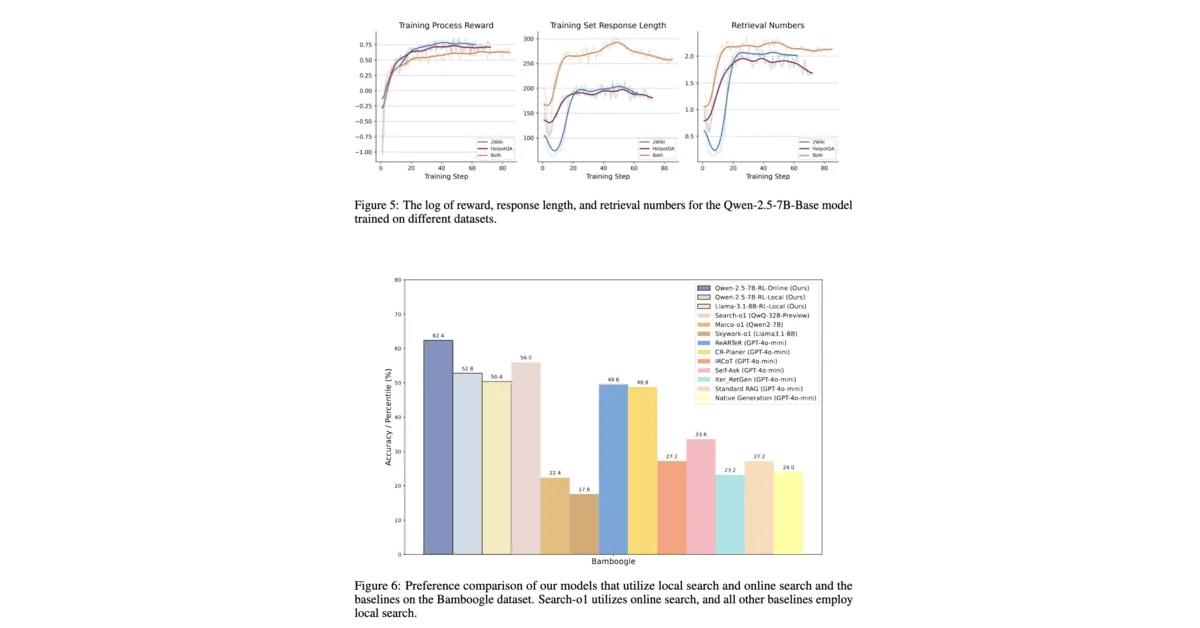
- HotpotQA Dataset: Improved accuracy by 48.22% compared to existing retrieval-augmented techniques.
- 2WikiMultiHopQA Dataset: Achieved a 21.72% increase in performance, demonstrating superior ability to handle multi-hop reasoning tasks.
- Bamboogle Dataset: Outperformed existing retrieval-based models by 11.4%, showcasing enhanced generalization capabilities.
Key Advantages Over Previous Approaches
- Higher accuracy in reasoning tasks: The model significantly improves upon previous retrieval methods by autonomously selecting relevant information.
- Stronger generalization across different datasets: Unlike supervised fine-tuning, which risks overfitting, reinforcement learning allows R1-Searcher to adapt to diverse scenarios.
- Reduced reliance on expensive computational resources: By optimizing retrieval rather than memorization, it enhances efficiency without the need for large-scale fine-tuning.
- Minimized hallucinations and misinformation: External search integration ensures fact-based responses, reducing AI-generated errors.
The Future of AI: Reinforcement Learning for Smarter LLMs
The findings from R1-Searcher demonstrate that reinforcement learning can significantly enhance LLMs’ ability to access, retrieve, and integrate knowledge dynamically. This breakthrough could pave the way for more accurate and reliable AI systems, especially in domains requiring up-to-date and domain-specific information.
Potential Applications:
- Healthcare: Enhancing AI-powered medical diagnosis by integrating the latest research and treatment guidelines.
- Finance: Improving real-time stock market analysis, risk assessment, and fraud detection.
- Education: Providing accurate and updated learning materials for students and teachers.
- Customer Support: Reducing misinformation in AI-powered chatbots and virtual assistants.
- Legal and Compliance: Ensuring accurate legal research and regulatory compliance by integrating the latest policies and case laws.
Conclusion: A Step Towards Smarter AI
R1-Searcher represents a major advancement in AI research, addressing the limitations of current LLMs through reinforcement learning. By allowing models to refine their retrieval strategies autonomously, this framework ensures better accuracy, adaptability, and generalization. As AI continues to evolve, integrating RL-based search capabilities will be essential for developing more reliable and intelligent language models.
Want to learn more about AI advancements? Stay updated with the latest breakthroughs in LLM research.
Frequently asked questions.
Answers connected directly to this article and its subject.
01 What is R1-Searcher?
R1-Searcher is a reinforcement learning framework designed to enhance LLMs’ ability to retrieve and integrate external knowledge autonomously.
02 How does R1-Searcher improve LLM accuracy?
It trains models in two stages: first, learning when to invoke external searches, and second, optimizing retrieved data for more accurate responses.
03 What makes R1-Searcher different from other retrieval-based approaches?
Unlike traditional methods that rely on supervised fine-tuning, R1-Searcher uses reinforcement learning to refine search strategies dynamically, improving adaptability and efficiency.