Meet Baichuan-M1: Revolutionizing Medical AI with a Focus on Specialized Medical Knowledge
In recent years, large language models (LLMs) like GPT-4 and DeepseekR1 have shown impressive performance in a wide range of industries. However, despite their success in general applications, these models struggle to meet the specialized demands of fields like healthcare. The complexity of medical knowledge, coupled with challenges in obtaining high-quality, domain-specific data, makes developing highly efficient medical LLMs particularly difficult. Enter Baichuan-M1: a new series of large language models designed from the ground up to tackle the unique requirements of the medical field. In this article, we’ll explore how Baichuan-M1 is set to revolutionize AI-driven medical capabilities and why it’s an important step forward in medical AI.
The Challenges of Medical AI
Lack of High-Quality Training Data
One of the primary challenges in developing specialized LLMs for medicine is the lack of access to high-quality, domain-specific data. Medical data is often highly protected due to privacy concerns and regulatory barriers. Furthermore, the complexity of medical language, with its vast array of terms, diseases, and treatments, makes training models on such data exceptionally difficult. While there are general datasets available, they often fail to capture the nuances and intricacies required for accurate medical interpretation and decision-making.
Fine-Tuning vs. From Scratch: Why Existing Approaches Fall Short
Many attempts at developing medical AI have relied on fine-tuning general-purpose models like GPT-4 on medical datasets. While this approach has had some success, it often results in models that perform well on specific tasks but lack the deep understanding needed for complex medical queries. The models tend to struggle with interpreting highly technical language or providing contextually accurate responses in fast-evolving medical environments.
Baichuan-M1 sets itself apart by addressing these issues head-on.
Baichuan-M1: A New Era in Medical AI
Trained on 20 Trillion Tokens
The Baichuan-M1 series is built from the ground up with a dedicated focus on medical expertise. Trained on 20 trillion tokens, Baichuan-M1 blends general data with specialized medical information, striking the perfect balance between broad language understanding and precision in medical contexts. This training approach ensures the model can handle not only general tasks like coding and mathematics but also complex medical applications such as diagnostic reasoning, treatment recommendations, and more.
Key Features of Baichuan-M1
- Optimized Transformer Architecture: Baichuan-M1 leverages a state-of-the-art Transformer architecture, which is enhanced with novel techniques like pre-norm RMSNorm and rotary position embeddings. These innovations help improve both the efficiency and accuracy of the model’s performance.
- Hybrid Tokenizer: The model employs a hybrid tokenizer that seamlessly handles both medical-specific and general text. This design allows Baichuan-M1 to excel in a variety of domains, from clinical notes to scientific literature.
- Curriculum-Based Training Strategy: Instead of traditional fine-tuning, Baichuan-M1 uses a curriculum-based training strategy. This progressive approach gradually increases data complexity to allow the model to learn medical knowledge in a structured, coherent manner, similar to how a human might master a new field.
- Supervised Fine-Tuning for Specialized Tasks: After its initial training, Baichuan-M1 undergoes supervised fine-tuning that targets specific medical tasks. This step refines the model’s reasoning abilities, ensuring it can handle complex medical scenarios while maintaining a high level of general language comprehension.
Performance and Real-World Applications
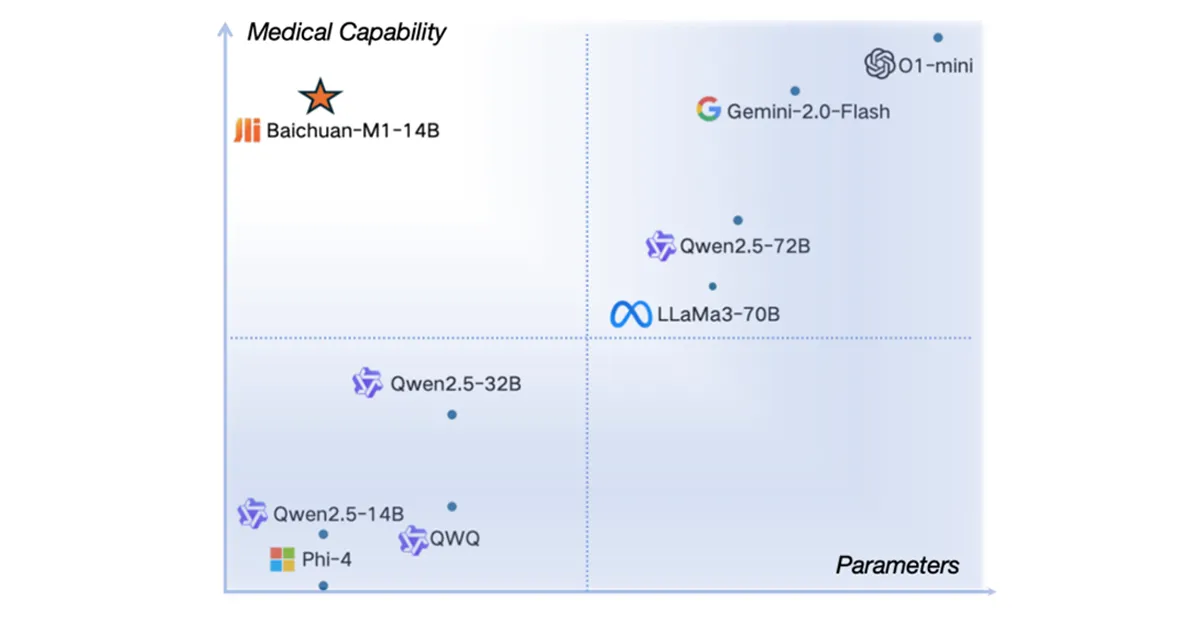
Baichuan-M1 has demonstrated strong performance on several benchmarks, including code generation and mathematical reasoning tasks. Using frameworks like EvalPlus and Bigcodebench, Baichuan-M1-14B-Base has been tested for its capabilities in code generation, while datasets like MATH and CMATH have evaluated its mathematical proficiency. While it still lags behind some proprietary models like GPT-4o and Claude-3.5-Sonnet in certain areas, its performance has narrowed the gap significantly, especially in medical-related tasks.
These advancements are crucial in medical AI, where accurate reasoning and the ability to process complex, unstructured data are essential.
The Potential Impact of Baichuan-M1 in Healthcare
Improving Diagnostics and Treatment Recommendations
Baichuan-M1’s ability to understand and process medical terminology with high accuracy makes it an ideal tool for diagnosing diseases, interpreting medical records, and offering treatment suggestions. Unlike traditional LLMs that might struggle with specialized terminology, Baichuan-M1’s deep understanding of medical data allows it to make highly informed decisions.
Enhancing Medical Research and Literature Review
Medical research is a field that evolves rapidly, with new findings published daily. Baichuan-M1’s capacity to process vast amounts of data enables it to assist medical professionals in staying updated on the latest developments. Whether it’s interpreting research papers, summarizing findings, or providing insights into treatment efficacy, Baichuan-M1 is poised to support researchers and clinicians alike.
Addressing Rare Disease Diagnosis
One of the most significant challenges in medicine is diagnosing rare diseases, which often present with ambiguous symptoms. Baichuan-M1’s ability to analyze complex, rare cases and integrate knowledge from multiple sources may provide a breakthrough in this area, improving early diagnosis and treatment outcomes for patients with uncommon conditions.
Conclusion: A Step Forward in AI-Driven Healthcare
Baichuan-M1 represents a monumental leap in medical AI. By building a model specifically designed for the complexities of healthcare, Baichuan-M1 overcomes the limitations of traditional LLMs and offers a more accurate, nuanced understanding of medical data. Its ability to balance general and specialized knowledge, combined with its advanced architecture, positions it as a game-changer in AI-driven healthcare.
As Baichuan-M1 continues to evolve, we can expect further advancements in medical decision-making, diagnostic capabilities, and research, ultimately improving patient outcomes worldwide.
Frequently asked questions.
Answers connected directly to this article and its subject.
01 What is Baichuan-M1?
Baichuan-M1 is a new series of large language models designed specifically for the medical field, trained on 20 trillion tokens, to provide accurate medical diagnoses, treatment recommendations, and research support.
02 How does Baichuan-M1 differ from general LLMs like GPT-4?
Unlike general LLMs, Baichuan-M1 is built from scratch with a focus on medical expertise, using specialized training data to improve its understanding of medical terminology and complex scenarios.
03 What are the main applications of Baichuan-M1 in healthcare?
Baichuan-M1 can be used for diagnostic support, treatment recommendations, literature review, and improving rare disease diagnosis.
04 How does Baichuan-M1 perform compared to other AI models?
While Baichuan-M1 is still evolving, it has shown strong performance in code generation and medical reasoning, closing the gap with proprietary models in many areas.
05 What challenges remain in the development of medical AI?
Challenges include access to high-quality training data, regulatory barriers, and the complexity of medical knowledge, all of which Baichuan-M1 addresses with its innovative training strategies.