
- APT29 Unleashes GRAPELOADER Malware: A New Threat to European Diplomats
- What Is APT29 and Why Does It Matter?
- A Brief History of APT29’s Cyber Exploits
- <strong>How Does GRAPELOADER Malware Work?</strong>
- Comparison with WINELOADER
- <strong>A Broader Context: Gamaredon’s Parallel Attacks</strong>
- How to Protect Against GRAPELOADER Malware and Similar Threats
- The Bigger Picture: Cyber Espionage in 2025
- Key Takeaways
APT29 Unleashes GRAPELOADER Malware: A New Threat to European Diplomats
In the shadowy world of cyber espionage, Russian state-sponsored hackers are raising the stakes. The notorious APT29, also known as Cozy Bear or Midnight Blizzard, has launched a sophisticated phishing campaign targeting European diplomats with a new malware loader called GRAPELOADER Malware. This article dives deep into the mechanics of this cyberthreat, its implications for global diplomacy, and how organizations can stay one step ahead of these digital predators.
What Is APT29 and Why Does It Matter?
APT29, linked to Russia’s Foreign Intelligence Service (SVR), is a cyber espionage group infamous for high-profile attacks, including the 2020 SolarWinds breach. Known for targeting government entities, think tanks, and diplomatic organizations, APT29’s latest campaign, uncovered in early 2025, showcases its evolving tactics. By deploying GRAPELOADER Malware alongside an updated WINELOADER backdoor, the group is zeroing in on Ministries of Foreign Affairs and embassies across Europe, with possible outreach to the Middle East.
Why should you care? In an era where geopolitics and cyberwarfare are intertwined, these attacks threaten sensitive diplomatic communications, potentially compromising national security. Let’s unpack how APT29 pulls off this digital heist.
A Brief History of APT29’s Cyber Exploits
- SolarWinds Attack (2020): Compromised multiple U.S. government agencies and private firms via a supply chain attack.
- DNC Hack (2016): Allegedly interfered in the U.S. presidential election, highlighting APT29’s global reach.
- Recent Trends (2025): Shift toward modular malware like GRAPELOADER Malware, emphasizing stealth and persistence.
How Does GRAPELOADER Malware Work?
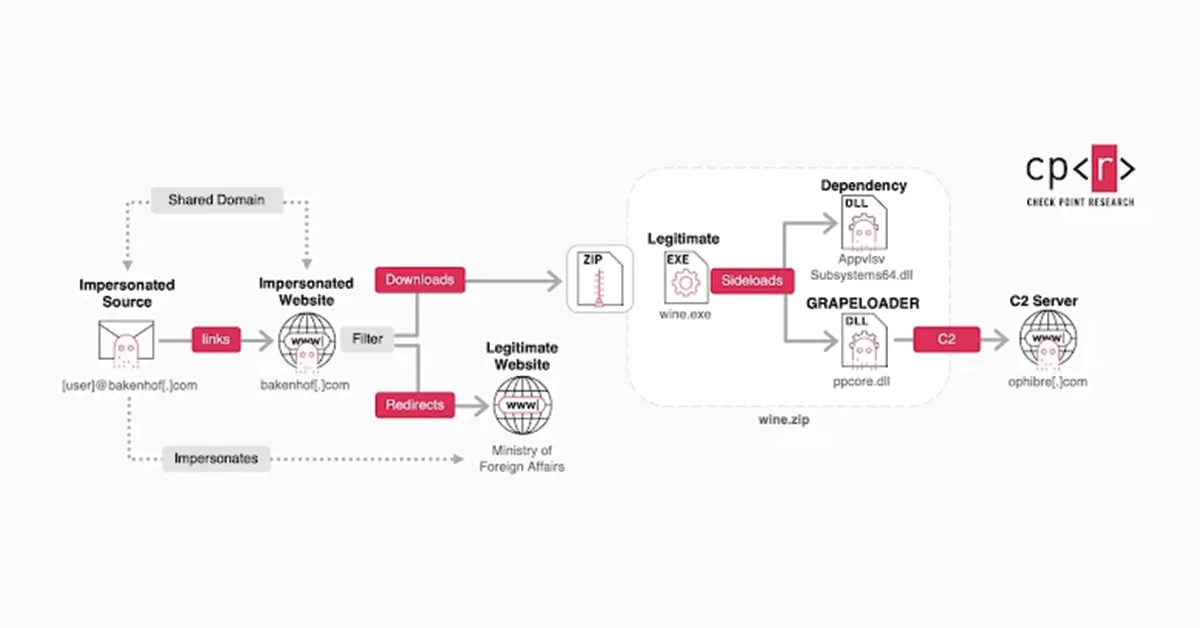
GRAPELOADER Malware is a first-stage malware loader designed for fingerprinting, persistence, and payload delivery. Unlike its predecessor, ROOTSAW, GRAPELOADER Malware refines anti-analysis techniques, making it harder for cybersecurity tools to detect. Here’s a step-by-step look at the attack chain, as detailed by Check Point’s analysis:
- Phishing Lure: APT29 sends emails impersonating a European Ministry of Foreign Affairs, inviting targets to a wine-tasting event. The emails, sent from domains like bakenhof[.]com and silry[.]com, contain a malicious ZIP archive named “wine.zip.”
- Malware Deployment: The ZIP includes a legitimate PowerPoint executable (“wine.exe”), a dependency DLL (“AppvIsvSubsystems64.dll”), and a malicious DLL (“ppcore.dll”). The executable is exploited for DLL side-loading, launching GRAPELOADER Malware.
- Persistence: GRAPELOADER Malware modifies the Windows Registry to ensure “wine.exe” runs on system reboot, maintaining access to the infected device.
- Data Exfiltration: The malware collects basic host information and communicates with a command-and-control (C2) server to fetch next-stage shellcode, likely leading to WINELOADER deployment.
This multi-stage approach, combined with string obfuscation and runtime API resolving, makes GRAPELOADER Malware a formidable tool in APT29’s arsenal.
Comparison with WINELOADER
While GRAPELOADER Malware handles initial infection, WINELOADER is a modular backdoor used in later stages. Both share code structure and obfuscation techniques, but GRAPELOADER Malware introduces advanced stealth methods, replacing the older ROOTSAW HTA downloader. This evolution underscores APT29’s focus on adaptability in 2025.
Why Diplomats Are Prime Targets
Diplomats are the gatekeepers of sensitive information—think classified communications, trade negotiations, and military strategies. By targeting Ministries of Foreign Affairs and embassies, APT29 aims to:
- Steal Intelligence: Access documents that could influence Russia’s geopolitical strategies.
- Disrupt Diplomacy: Undermine trust between nations by exposing confidential exchanges.
- Expand Reach: Use compromised systems as stepping stones to target allied nations.
The wine-tasting lure is particularly cunning, exploiting the social nature of diplomatic events. Who wouldn’t click on an invite to a prestigious gathering? This social engineering tactic highlights APT29’s knack for blending psychological manipulation with technical prowess.
A Broader Context: Gamaredon’s Parallel Attacks
While APT29 targets diplomats, another Russian group, Gamaredon, is hitting Ukraine with PteroLNK malware. Unlike APT29’s polished approach, Gamaredon prioritizes volume over stealth, using heavily obfuscated VBScript to infect USB drives and spread across networks. HarfangLab’s 2025 report notes PteroLNK’s ability to replace legitimate files with malicious shortcuts, a tactic that contrasts with APT29’s targeted precision but underscores Russia’s multifaceted cyber strategy.
How to Protect Against GRAPELOADER Malware and Similar Threats
Cybersecurity isn’t just for tech experts—it’s a shared responsibility. Here are actionable steps to safeguard your organization from APT29’s attacks:
- Train Staff on Phishing: Educate employees to spot suspicious emails, especially those with urgent or enticing lures like event invites.
- Implement Endpoint Detection: Use advanced antivirus and endpoint detection tools to catch DLL side-loading and registry modifications.
- Segment Networks: Limit lateral movement by isolating critical systems from general networks.
- Monitor for Anomalies: Deploy intrusion detection systems to flag unusual C2 communications.
- Stay Updated: Regularly patch software to close vulnerabilities exploited by malware loaders.
For deeper insights, check out our guide on cybersecurity best practices or explore Check Point’s technical analysis for a detailed breakdown.
The Bigger Picture: Cyber Espionage in 2025
The rise of GRAPELOADER Malware reflects a broader trend in cyber espionage: state-sponsored actors are getting smarter, faster, and bolder. According to a 2025 report by Google’s Mandiant, APT29’s campaigns are increasingly modular, allowing hackers to swap components and evade detection. Meanwhile, the global cybersecurity market is projected to hit $300 billion by 2026, driven by the need to counter such threats. Are we keeping up, or are we always one step behind?
Key Takeaways
APT29’s GRAPELOADER campaign is a wake-up call for governments and organizations worldwide. By blending sophisticated malware with clever social engineering, these hackers are rewriting the rules of cyber espionage. Stay vigilant, train your team, and invest in robust defenses to keep your data safe. Curious about the latest cyberthreats? Discover more and join the fight against digital espionage.
Share your thoughts on cyber espionage in the comments or explore our cybersecurity resources!
Frequently asked questions.
Answers connected directly to this article and its subject.
01 What is GRAPELOADER malware?
GRAPELOADER is a first-stage malware loader used by APT29 to infect systems, ensure persistence, and deliver payloads like WINELOADER.
02 Who is APT29 targeting with GRAPELOADER?
APT29 primarily targets European diplomats, focusing on Ministries of Foreign Affairs and embassies, with possible outreach to the Middle East.
03 How does APT29 deliver GRAPELOADER?
The malware is delivered via phishing emails with wine-tasting lures, containing a ZIP archive that triggers DLL side-loading.
04 What makes GRAPELOADER different from WINELOADER?
GRAPELOADER handles initial infection and persistence, while WINELOADER is a modular backdoor for later-stage attacks.
05 How can organizations protect against GRAPELOADER?
Train staff on phishing, use endpoint detection, segment networks, monitor anomalies, and keep software updated.