- Reinforcement Learning with Verifiable Reward: Alibaba’s R1-Omni and the Future of Emotion Recognition
- Understanding R1-Omni: A Breakthrough in Emotion Recognition
- What is R1-Omni?
- Key Features of R1-Omni
- Experimental Results: How Does R1-Omni Perform?
- Future Implications and Research Directions
- Conclusion
Reinforcement Learning with Verifiable Reward: Alibaba’s R1-Omni and the Future of Emotion Recognition
Emotion recognition from videos presents significant challenges, particularly in accurately interpreting the interplay between visual and auditory cues. Traditional models relying solely on facial expressions or tone of voice often misinterpret emotions, leading to unreliable predictions. Additionally, many models lack transparency in their decision-making process, making it difficult to understand how specific emotions are detected.
To address these issues, researchers at Alibaba have introduced R1-Omni, an innovative application of Reinforcement Learning with Verifiable Reward (RLVR) to an omni-multimodal large language model. This new approach not only enhances accuracy but also improves interpretability, setting a new standard for multimodal emotion recognition.
Understanding R1-Omni: A Breakthrough in Emotion Recognition
The Challenge of Multimodal Emotion Recognition
- Many emotion recognition models struggle to effectively combine visual and auditory signals.
- Explanations generated by these models often fail to accurately reflect input data.
- The need for a transparent and verifiable decision-making process is crucial for practical applications.
- Current AI models are prone to biases, misinterpreting emotions based on incomplete or misleading data.
- Existing solutions lack real-world adaptability, making them unreliable for diverse emotional expressions across cultures and settings.
What is R1-Omni?
R1-Omni builds upon the HumanOmni framework, integrating RLVR to fine-tune the model for handling both video and audio data. It begins with a cold start phase, where the model is pre-trained on a combination of Explainable Multimodal Emotion Reasoning (EMER) data and manually annotated datasets. Once the model gains basic reasoning capabilities, RLVR refines it further, optimizing both accuracy and interpretability.
Key Features of R1-Omni
Reinforcement Learning with Verifiable Reward (RLVR)
RLVR introduces a reward-based learning system that ensures reliable predictions. The model receives:
- A reward of 1 if its emotion prediction matches the ground truth.
- A reward of 0 if the prediction is incorrect.
- Additional format rewards for ensuring structured and interpretable reasoning.
This approach eliminates subjective human feedback, making the training process objective and reproducible.
Group Relative Policy Optimization (GRPO)
GRPO refines the model by comparing multiple candidate responses, allowing R1-Omni to:
- Identify and prioritize coherent, interpretable predictions.
- Reduce instances of unsupported reasoning.
- Improve overall prediction quality and reliability.
Improved Generalization and Performance
The model demonstrates strong generalization capabilities, performing well even on unseen datasets like RAVDESS, a standardized speech and emotion dataset featuring professional actors.
Additionally, R1-Omni adapts effectively to real-world scenarios, capturing nuanced expressions across diverse demographics and emotional contexts.
Experimental Results: How Does R1-Omni Perform?
Benchmark Comparisons
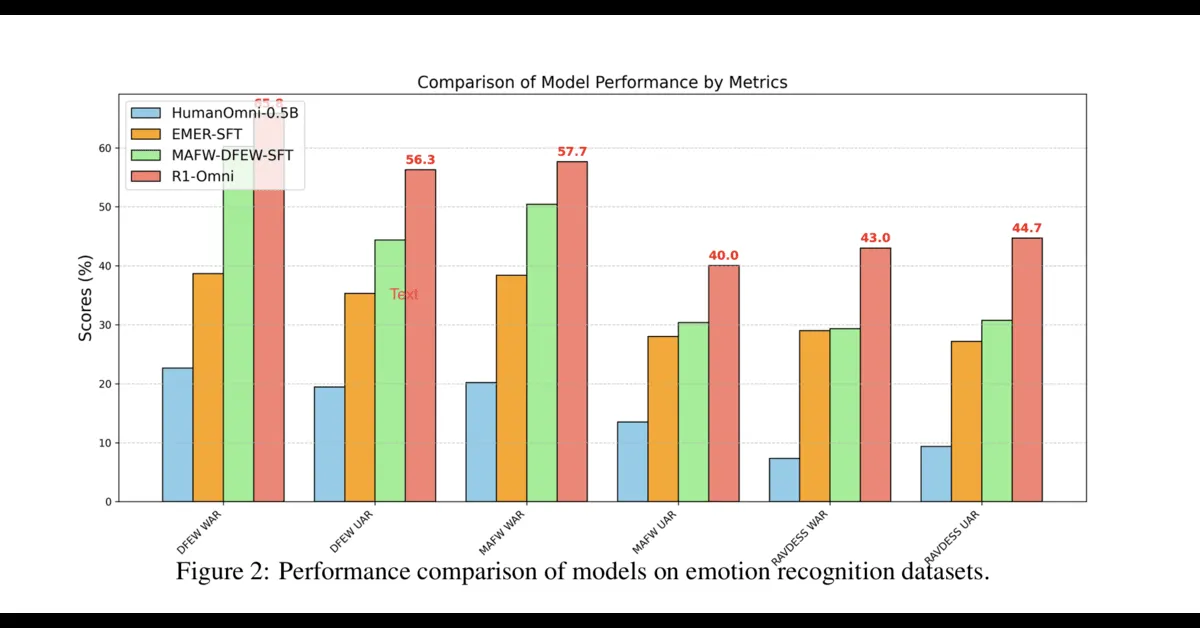
R1-Omni was evaluated against baseline models such as HumanOmni-0.5B and supervised fine-tuning (SFT) models trained on datasets like EMER and MAFW-DFEW.
Key Findings:
- On the DFEW dataset:
- Unweighted Average Recall (UAR): 65.83%
- Weighted Average Recall (WAR): 56.27%
- On the MAFW dataset:
- Notable improvement in emotion classification across various classes.
- On the RAVDESS dataset:
- Demonstrated strong generalization capabilities, maintaining consistent performance.
- Higher stability in recognizing subtle emotional shifts, improving overall contextual accuracy.
Why These Results Matter
- Higher recall rates indicate better emotion detection accuracy.
- The model produces interpretable, structured explanations, improving trust and usability in real-world applications.
- Stronger generalization means R1-Omni can adapt to different datasets and scenarios.
- Enhanced reasoning enables richer explanations for how emotions are derived from video and audio sources.
Future Implications and Research Directions
While R1-Omni marks a significant advancement, there is still room for improvement:
- Enhancing subtitle recognition to improve the understanding of spoken emotions.
- Reducing unsupported reasoning instances to refine model accuracy.
- Improving audio signal integration to detect nuanced emotional expressions.
- Expanding dataset diversity to train the model on a wider range of cultural and linguistic expressions.
- Exploring multimodal bias reduction techniques to ensure equitable and accurate emotion detection across all users.
By refining these aspects, future iterations of R1-Omni could further revolutionize emotion AI, making it more robust, interpretable, and applicable to diverse fields like customer service, healthcare, and human-computer interaction.
Conclusion
R1-Omni represents a major step forward in multimodal emotion recognition, addressing the long-standing challenges of interpretability, accuracy, and generalization. By leveraging Reinforcement Learning with Verifiable Reward, it ensures structured, explainable, and precise emotion detection.
As research continues, the integration of multimodal AI into real-world applications will become more seamless, ultimately enhancing human-computer interactions across industries. Stay updated on the latest AI breakthroughs! Subscribe now and explore the future of emotion recognition.
Frequently asked questions.
Answers connected directly to this article and its subject.
01 What is R1-Omni?
R1-Omni is an AI model developed by Alibaba that leverages Reinforcement Learning with Verifiable Reward (RLVR) to improve emotion recognition from video and audio data.
02 How does RLVR improve emotion recognition?
RLVR provides an objective reward system, ensuring that the model produces accurate and interpretable predictions without relying on subjective human feedback.
03 How does R1-Omni compare to traditional emotion recognition models?
Unlike traditional models, R1-Omni effectively integrates both visual and auditory signals, providing structured reasoning for its predictions.
04 What are some potential applications of R1-Omni?
R1-Omni could enhance customer service, mental health analysis, AI-driven storytelling, and human-computer interaction.
05 Can R1-Omni adapt to new datasets?
Yes! R1-Omni exhibits strong generalization capabilities, making it effective even on unseen datasets like RAVDESS.